.svg)

Overview
Illinois regulators recently made an important change to how they track cannabis sales, and that change has big implications for how the industry understands the size of the market. Accurate estimates of the size of any market are critical for operators to effectively measure performance and forecast demand.
At Headset, we rely on government-reported totals as the foundation for our market models. When the underlying rules change, we owe it to our customers - and to the broader industry - to revisit our assumptions, fix what’s out of date, and explain exactly what we did.
This post walks through:
- What changed in Illinois
- Why the original data suddenly showed a “cliff” in sales
- How Headset used discounts and our retail sample to rebuild a more accurate history
What changed in Illinois?
In November 2025, the Illinois Department of Financial and Professional Regulation (IDFPR) announced that the state has fully transitioned to the METRC traceability system for cannabis. Along with that transition, they released updated sales totals and explained that:
The sales tracking features in Metrc help retailers more accurately and reliably report actual sales, including all discounts and promotions at checkout. A thorough review of past data indicates prior months collected some pre-discount prices.
In simple terms:
- Before METRC (through May 2025):
- Some retailers were effectively reporting what was on the shelf before coupons, promos, or discounts were applied.
- After METRC (June 2025 onward):
- Retailers are reporting what customers actually paid at the register, after discounts.
That sounds like a small accounting detail, but it has real impact, especially in a market where discounts have become a major part of the pricing landscape.
Discounts have grown a lot in Illinois
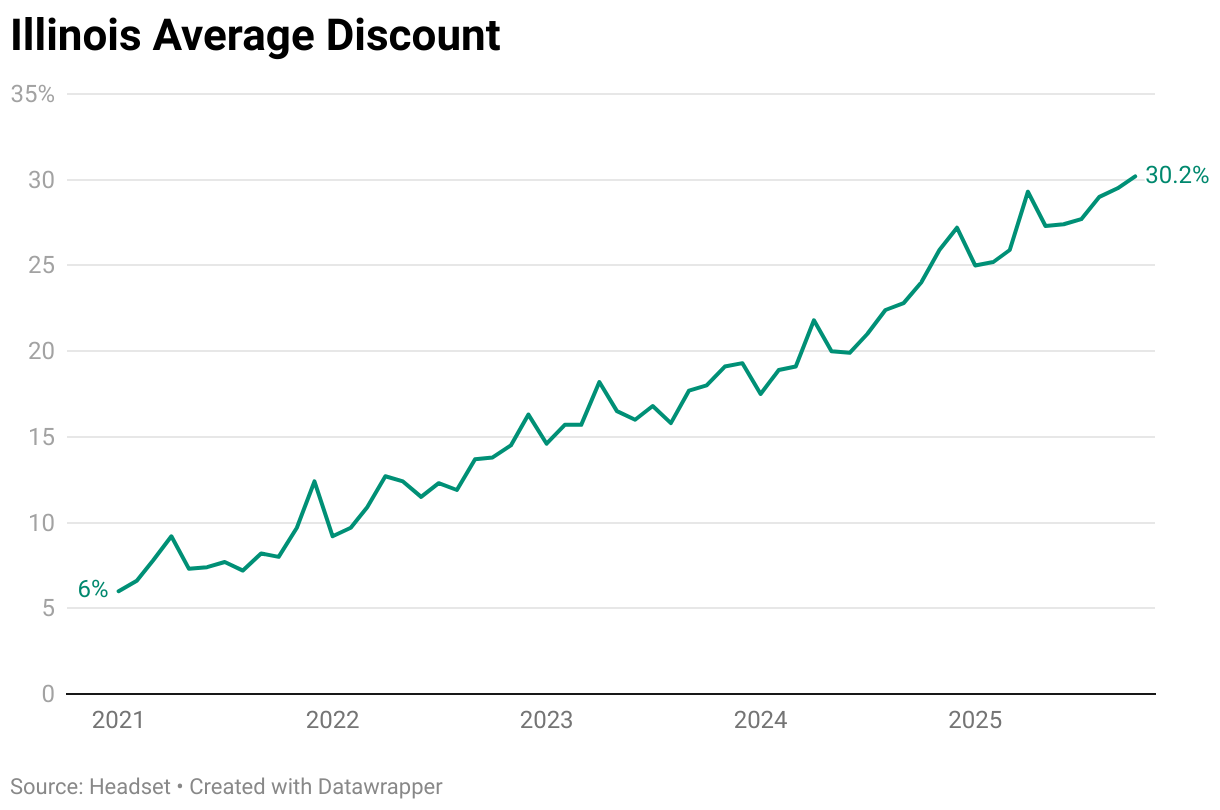
In Headset’s connected Illinois retail sample, we’ve seen average discounts climb from about 6% in January 2021 to just over 30% by October 2025. That means the gap between “sticker price” and “what the customer actually pays” has widened over time.
When discounts are small, reporting pre-discount vs. post-discount prices doesn’t change the picture very much. But once discounts hit 20–30%, using the wrong definition can make the market look significantly larger than it really is.
Headset’s methodology has always used post-discount, pre-tax sales at the receipt level - that is, what the consumer actually paid before taxes. The old, pre-METRC Illinois state totals didn’t fully match that standard, and the mismatch grew more important as discounting increased.
The “cliff” in May → June 2025
When Illinois published METRC-based totals for June–October 2025, a big issue became immediately obvious.
- IDFPR published totals:
- May 2025: roughly $171M
- June 2025: roughly $132M
- Month-over-month change: –22.6%
- Headset’s Illinois sample:
- Same-store and total-sample sales fell only 6–7% from May to June.
A 6–7% pullback is normal market noise. A 22% crash - overnight, with no major policy change - is not.
What happened is that June 2025 is the first full month where the state is measuring post-discount sales, while May 2025 and earlier are inflated by pre-discount values. So instead of a real collapse in demand, the data is mostly showing a change in measurement.
If we left the old Illinois numbers as-is, our Insights trendlines would show an artificial crash mid-2025 that we know doesn’t reflect reality.
How Headset responded
Step 1: Update June–October 2025 to match METRC
Before Illinois released the new data, Headset had been forecasting June–October 2025 totals based on the May 2025 state figure and trends in our retail panel. Once the official METRC totals became available, we replaced our forecasts with the newly published state numbers.
Because those forecasts were based on the older, pre-discount methodology, this match-back results in topline restatements of roughly –17% to –20% for June through October 2025 compared to what was previously shown in Insights.
That’s a big change, but it brings Illinois in line with how the state now defines sales.
Step 2: Bring the rest of history onto the same basis
We didn’t want a market where:
- Post-June 2025 numbers are post-discount, and
- Pre-June 2025 numbers are a mix of pre- and post-discount practices.
So our analytics team rebuilt the historical series from January 2021 through May 2025 to put everything on a consistent post-discount, pre-tax basis.
We did this using three ingredients:
- The state’s original monthly totals
- Headset’s average discount rate each month in Illinois
- Headset’s retail panel trends, especially the May→June 2025 change
Conceptually, we asked:
“Given what we know about average discounts and how our same-store sales changed from May to June, how much were the old state totals overstated? And how should we scale them down so that the May→June drop in the state series looks like the drop we actually see in our stores?”
From that exercise, we estimated that about 64% of the average discount value was being mishandled in the old reporting - not all of it, but a meaningful chunk. We then applied a consistent discount-based adjustment to all pre-METRC months.
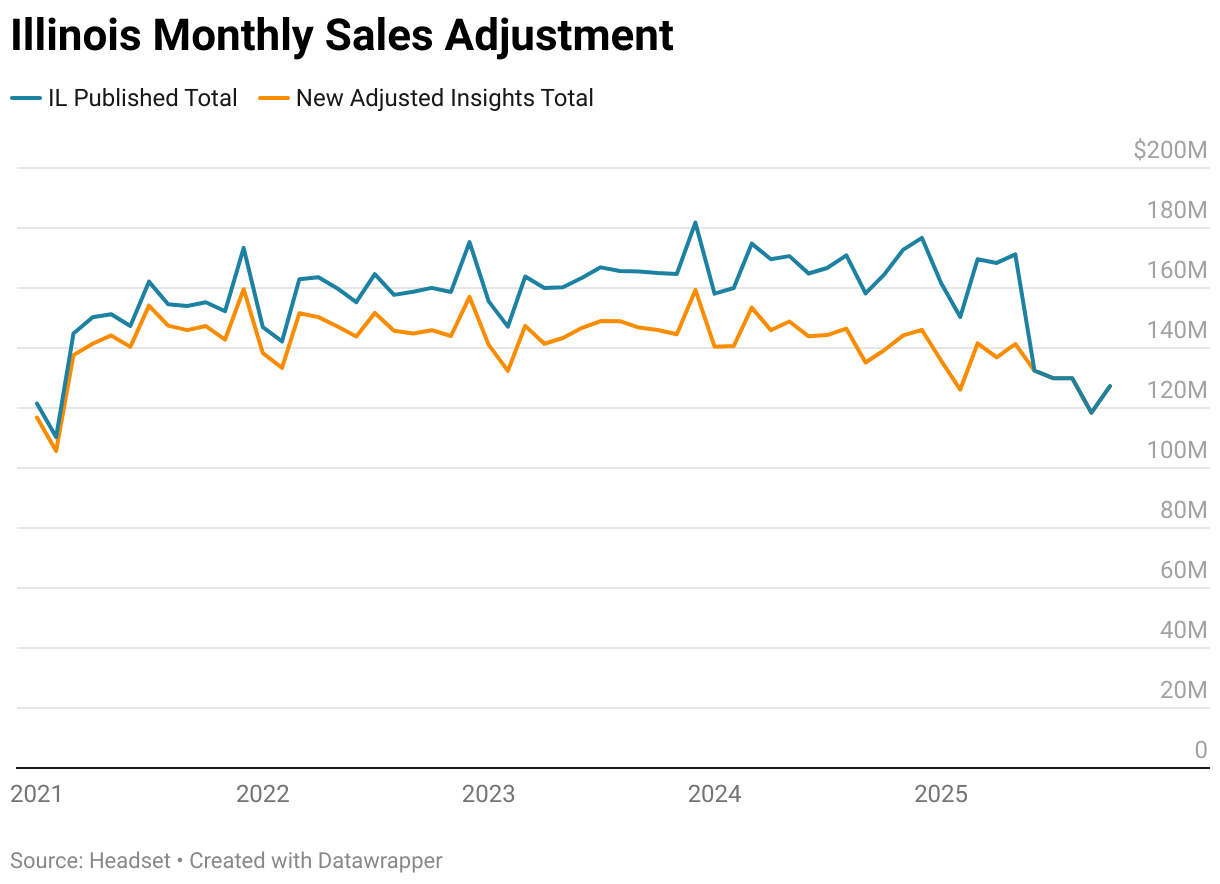
The result is a new “Illinois true net sales” series that:
- Matches the state’s METRC totals from June 2025 onward
- Scales down earlier months to a realistic, post-discount level
- Removes the artificial cliff in mid-2025
You can see the impact in the chart below, where the blue line is the original state series and the orange line is the new Headset-adjusted total:
What this means for Illinois market sizing
Putting it all together:
- January 2021–May 2025:
- Illinois totals in Headset are now lower than before, with the size of the adjustment growing over time as discounts became more aggressive.
- The overall market trend and seasonality remain intact, but now reflect what consumers actually paid after discounts.
- June–October 2025:
- Headset previously showed forecasted totals using older methodology.
- These months have been revised downward by roughly 17–20% to match the newly released METRC-based state data.
- November 2025 and beyond:
- We will continue to forecast using our Illinois panel until the state publishes new METRC totals, and then reconcile to those official figures as they become available.
Throughout all of this, category, brand, and product market share within each month remain unchanged. When we adjust a month’s total, we scale every product equally, so your view of “who’s winning” inside Illinois doesn’t shift - only the size of the overall pie does.
Why we’re sharing this
Any time we touch historical data, we know it can be disruptive. But we also believe that being transparent and grounded in reality is more important than keeping a familiar line on a chart.
In this case:
- The state changed how it measures sales.
- Their new approach aligns much better with how Headset has always measured sales (post-discount, pre-tax).
- Leaving Illinois history unadjusted would exaggerate growth before 2025 and show a fake crash in June 2025.
By rebuilding Illinois on a consistent, after-discount basis, we’re giving the market:
- A cleaner view of true demand over time
- A more accurate foundation for investment, strategy, and benchmarking
- Full transparency into what changed and why
If you have questions about the methodology, or want to understand how these changes affect a specific report, our team is always happy to walk through the details.