
Prices Are Falling. Here’s Who’s Taking the Hit.

Introduction
For every $100 a store rings up, how much is left after paying for the product on the shelf?
Across 17 U.S. markets in September 2026, the answer was about $47. That's almost exactly where it was a year ago. But the national average hides big differences from state to state.
Margin by market
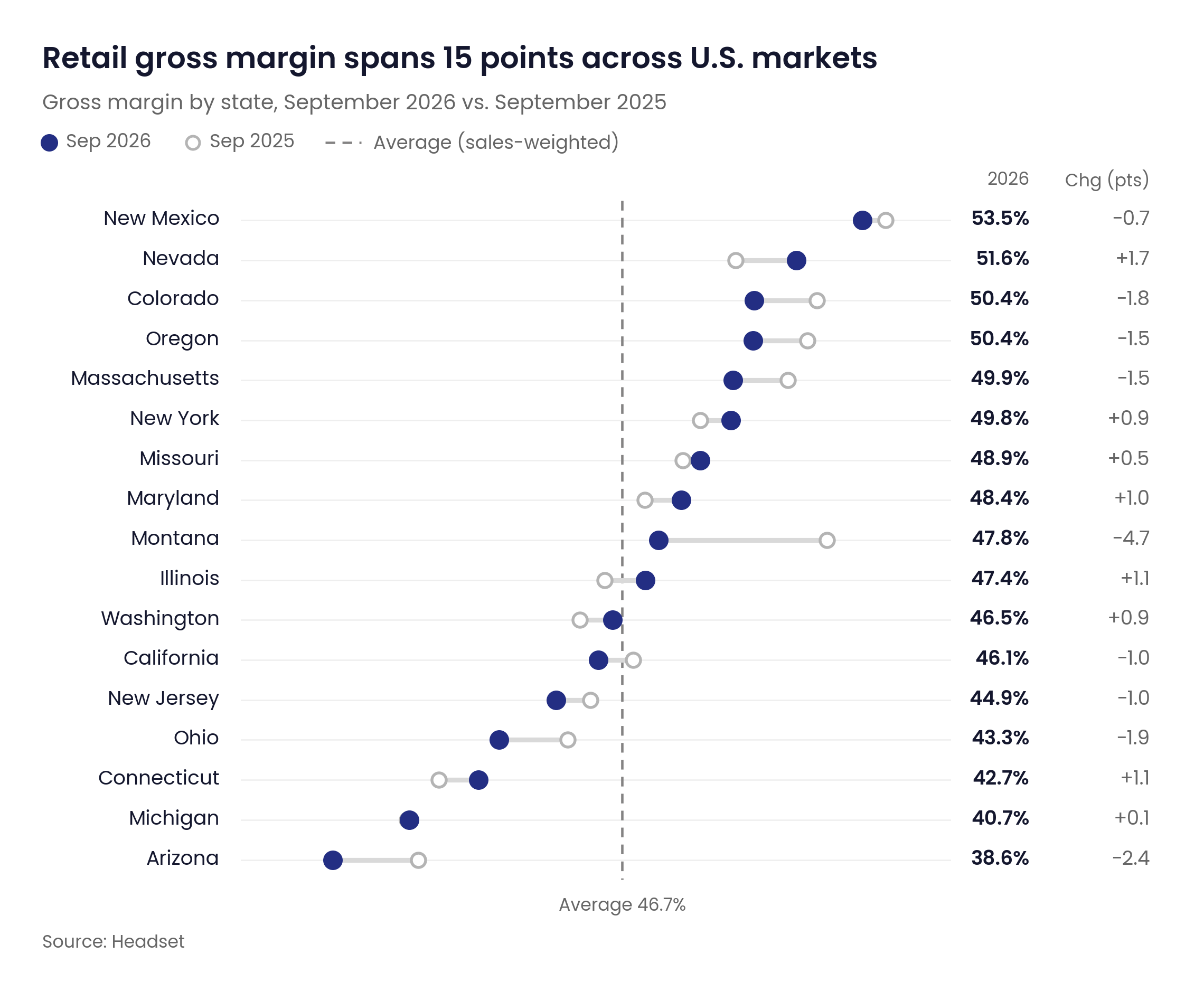
Chart placeholder: Retail gross margin spans 15 points across U.S. markets (gross margin by state, Sep 2026 vs. Sep 2025). Source chart: Claude Doc
New Mexico stores keep the most, about $54 of every $100. Arizona stores keep the least, under $39.
So what's going on?
Prices are falling almost everywhere. Products cost shoppers less than they did a year ago, and stores are handing out bigger discounts on top of that.
When prices fall, someone has to absorb the hit. There are only two options: the store keeps less of each sale, or the producer gets paid less for its product.
Which one it is depends on the market.
Where producers are eating the margin
In these markets, what stores pay for product fell faster than what they charge for it. Producers took less, so stores could discount more and still keep more of each sale.
- Connecticut and New York: shelf prices fell around 10%, but wholesale costs fell even more. New York stores doubled their discounting and still came out ahead.
- Illinois, Maryland and Missouri: stores discounted harder than last year, and margins went up anyway.
Where retailers are eating it
Arizona, Montana, Ohio and Colorado went the other way. Wholesale costs went up while shelf prices didn't keep pace, so stores got squeezed in the middle. Montana was hit hardest, losing nearly 5 points of margin in a year.
What it means for your store
Compare yourself to your market, not the nation. A 47% margin is great in Arizona and below par in New Mexico.
Watch what you pay as closely as what you charge. If your shelf prices are falling faster than your costs, that gap is worth bringing to your next vendor conversation.
Margins held this year. Next year depends on who blinks first on price.