.svg)
Sessionable, or Just Displaced? What's Actually Driving Low-Dose Cannabis Beverages

Introduction
The sessionable THC drink is the most-hyped product in cannabis: low-dose seltzers own the hemp aisle, and every trend piece says dispensaries are next. The data says otherwise, mostly.
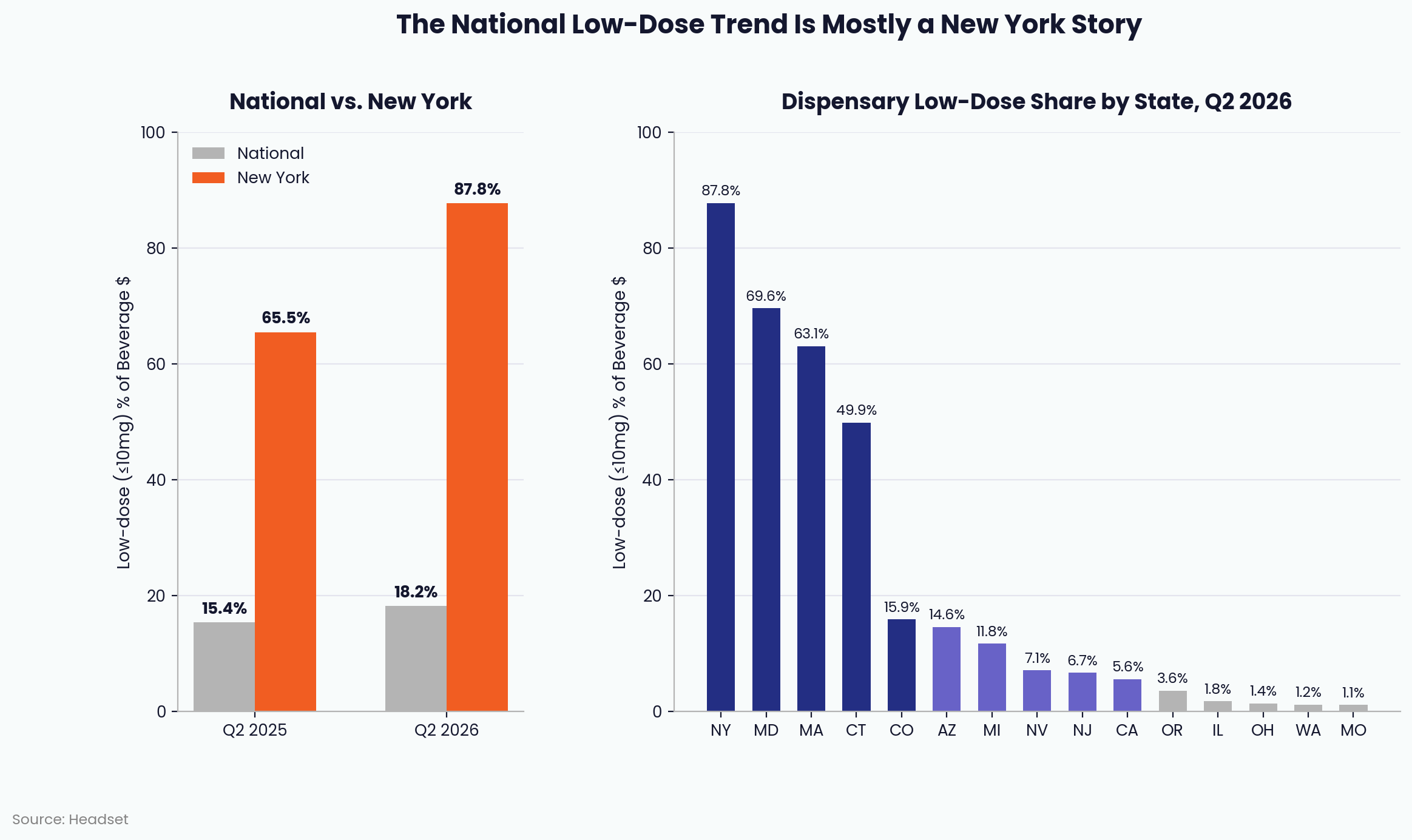
Nationally, products at 10mg THC or less grew from 15.4% to 18.2% of Beverage sales in Q2 2026, per our Q2 Beverage Industry Report. But 1.8 of those 2.8 points come from New York alone, where low-dose jumped from 65.5% to 87.8% of the state's beverage sales. Strip New York out and the national number is flat: 11.5% to 11.7%. Low-dose share actually fell in 9 of the 15 states we track, including every Western market (CA 5.6%, OR 3.6%, WA 1.2%, CO 15.9%, AZ 14.6%). It's rising mainly in New York, Massachusetts (63.1%), Connecticut (49.9%), New Jersey, and Ohio.
So the low-dose wave is geographic, not national. This piece maps why: which states let customers buy an intoxicating THC beverage outside a dispensary, how that reshapes the dispensary shelf, and what happens once a pending federal ban closes that outside channel everywhere.
Methodology
Dispensary sales data comes from real-time POS reporting via Headset's business intelligence software, covering WA, OR, CA, AZ, CO, MI, MA, NV, MD, IL, NY, OH, NJ, MO, and CT. Florida is excluded: its medical-only market is tracked separately and isn't comparable on these metrics.
Low-dose means 10mg or less total THC per package. All figures in this piece, including the low-dose shares, category-size comparisons, and Ohio's monthly data, are measured at the package level, not the serving level. Regulatory caps cited elsewhere in this piece (Colorado, New Jersey, Connecticut, Massachusetts) are set per serving, not per package; where a beverage is sold as a single-serving container, the two align, but a multi-serving product could carry a package total above 10mg while still complying with a low per-serving cap. Maryland is the exception, its law mandates one serving per container, so serving and package are the same there. Channel status and hemp potency caps reflect state law as of Q2 2026. Hemp-derived beverage sales through mainstream retail aren't included here as Headset only reports on licensed cannabis dispensaries.
The federal hemp ban's effective date was November 12, 2026 as of this writing. A Senate-passed stopgap would delay most of it to December 11, 2026, pending House action.
The hemp channel explains the map
Missouri sells almost no low-dose beverages in dispensaries (1.1%) because Missourians can buy an uncapped hemp-derived THC seltzer at the liquor store, at the same potency as a dispensary product. Illinois (1.8%) and, until its hemp channel closed in March, Ohio (1.4%) show the same pattern: where hemp competes at full dispensary potency, dispensaries specialize in high potency and cede the sessionable occasion.
Maryland, Connecticut, and Massachusetts look like exceptions, high dispensary low-dose share despite open hemp channels (Massachusetts has none). They aren't: all three cap dispensary beverage potency at or below the 10mg line, Maryland at 10mg per single-serving container, Connecticut at 5mg per serving, Massachusetts at 5.5mg. A compliant beverage in any of the three is low-dose by regulation, not consumer choice.
New York is the real test case. It has no hemp channel, but its dispensary cap, 10mg per serving and 100mg per package, is the same ceiling most adult-use markets use, so a dispensary there is just as free to stock a 100mg beverage as a 10mg one. It stocks low-dose anyway: 87.8% of Beverage sales. California, Washington, and Oregon also have no hemp channel and no unusual cap, yet stay firmly 100mg-first. So no hemp competition alone doesn't explain low-dose share: it takes both a closed hemp channel and a young market, and New York is the one state where that combination is demand, not a label requirement.
Two channels, one occasion
The hemp channel doesn't just shift dosage mix within dispensary Beverage sales. It shrinks the whole category.
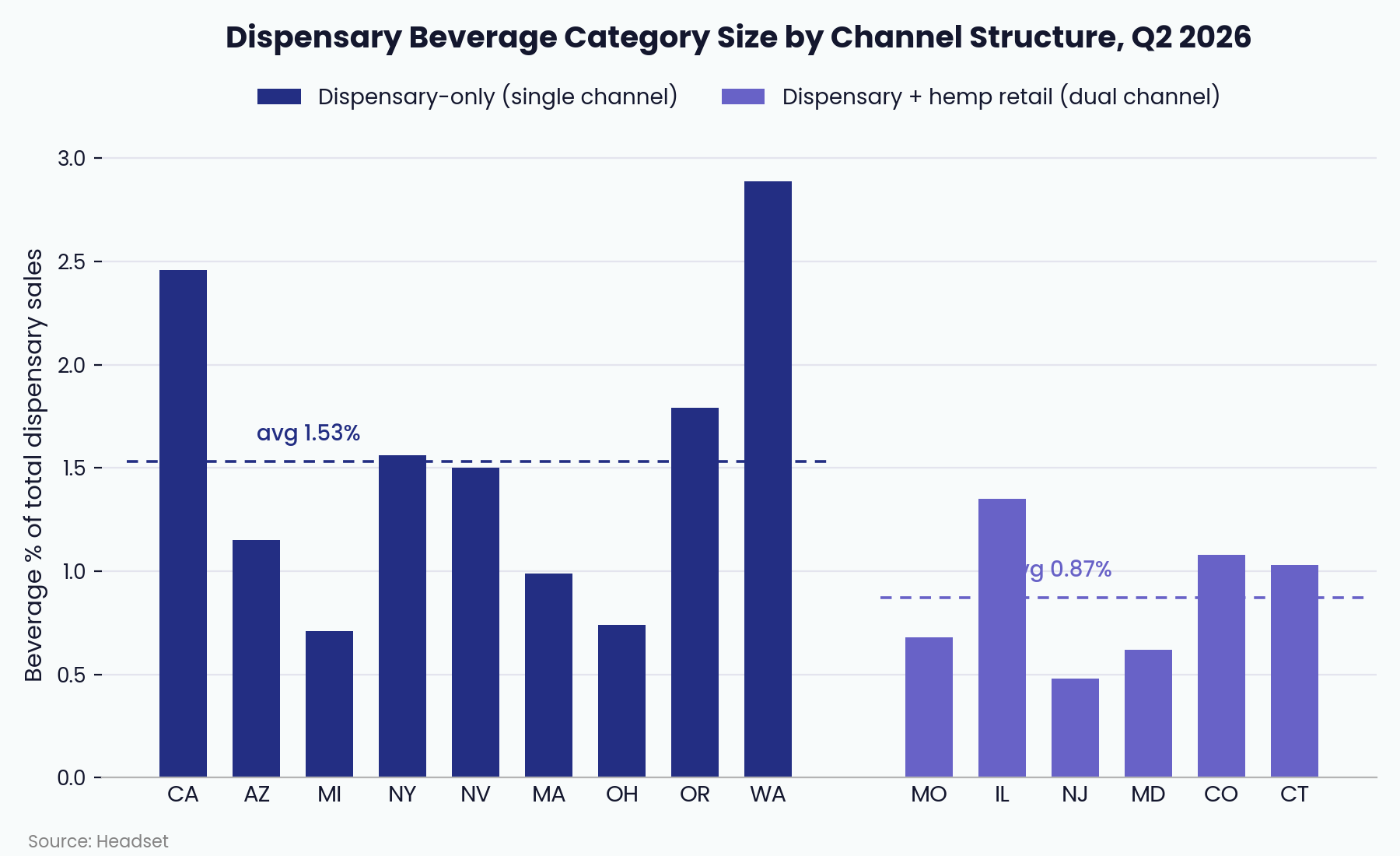
Split states into two groups: six where customers can buy an intoxicating THC beverage outside a dispensary (Missouri, Illinois, New Jersey, Maryland, Connecticut, and, at much lower potency, Colorado), and nine where dispensaries hold the entire licensed market (California, Washington, Oregon, Arizona, Nevada, Michigan, New York, Massachusetts, and Ohio since March).
Single-channel states average 1.5% of total dispensary sales in Beverage; dual-channel states average 0.9%, nearly double when there's nowhere else to buy the product. Washington and California post the highest Beverage shares tracked (2.9%, 2.5%); New Jersey and Maryland the lowest (0.5%, 0.6%).
But the size of the effect depends on what the hemp channel is allowed to sell. Where hemp beverages match dispensary potency (Missouri, Illinois), dispensaries exit the low-dose segment almost entirely, under 2% of Beverage sales. The category didn't shrink there, it moved.
Where the hemp cap sits below the low-dose threshold, dispensaries keep the segment. New Jersey caps hemp at 5mg/serving and retains 6.7% low-dose share. Colorado caps hemp at 1.75mg/serving, well below New Jersey's ceiling, and retains 15.9%, close to some single-channel Western markets. The liquor store product simply isn't dosed to compete.
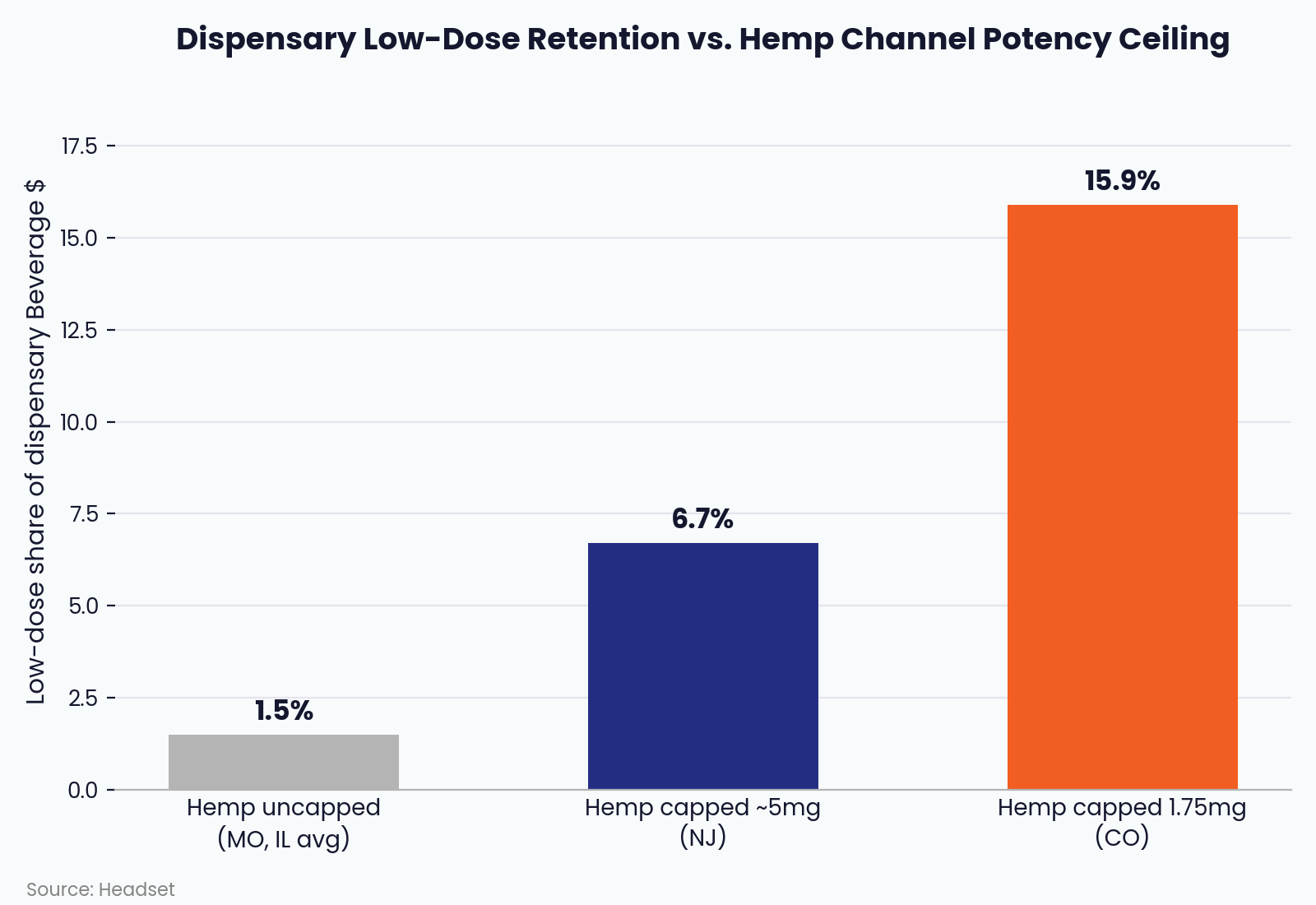
So this is a potency race, not a channel-presence question: the narrower the gap between what's legal off-shelf and on-shelf, the more completely hemp wins the low-dose occasion.
Ohio already ran this experiment
Ohio closed its hemp beverage channel in March 2026, giving us an actual before-and-after rather than a cross-state comparison.
Before closure, low-dose was near 0% of Ohio's Beverage sales in January and February, a true absence, not a rounding artifact. It appeared the month of closure (0.03%), then climbed: 0.46% in April, 1.57% in May, 2.01% in June. Total Beverage share of the store rose alongside it, from 0.62% pre-closure to 0.79% in July, roughly a 22% lift.
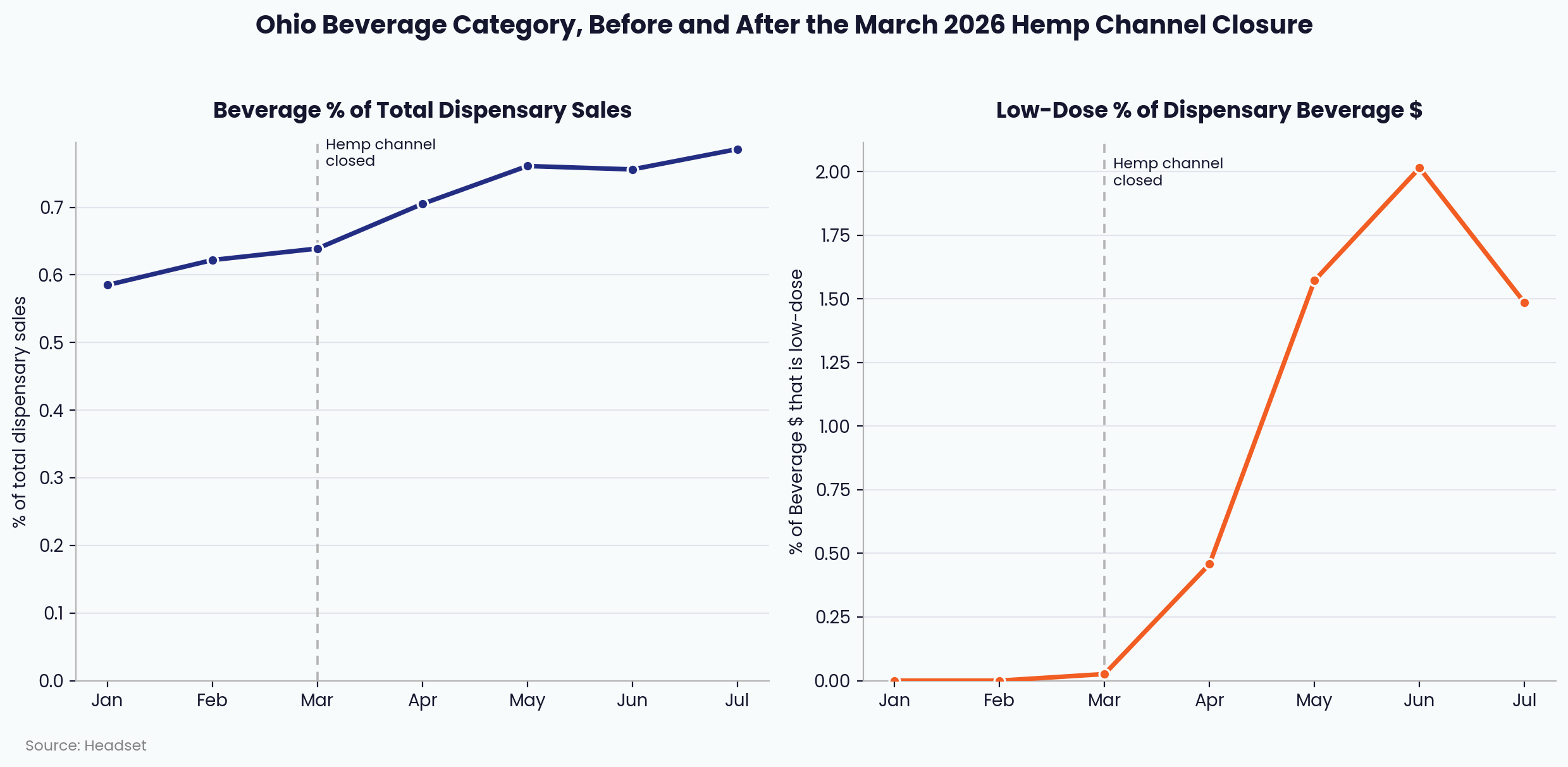
Two caveats: the scale is still small (2% peak, nowhere near Colorado's 15.9% or New York's 87.8%), and July dipped to 1.49%, one data point, not a reversal.
The takeaway is timing. Demand didn't disappear when the channel closed, but it took about a quarter to show up in dispensaries. That's the realistic timeline for the national market once the federal ban lands, not an overnight spike.
The federal ban changes the map
The federal hemp ban is set to take effect November 12, 2026 (a Senate-passed stopgap would push most of it to December 11, pending House action), capping any product at 0.4mg THC per container. That's below Colorado's cap, below New Jersey's, and nowhere near Missouri or Illinois's unrestricted hemp beverages. No current hemp beverage survives that line, whichever date lands. Every dual-channel state in this dataset becomes structurally single-channel.
If the single-channel average holds as a target, Missouri, Illinois, New Jersey, Maryland, Connecticut, and Colorado dispensary Beverage categories have room to roughly double their share of total sales, not from new demand, but from existing demand migrating in. Missouri and Illinois have the furthest to travel, since their dispensaries carry almost no low-dose assortment today; Colorado the least, since it already stocks one. Based on Ohio, expect that migration to take a quarter or two, not a single month.
Watch Beverage share of total sales in these six states from November onward, and watch whether low-dose specifically is what grows.
For brands: get low-dose SKUs licensed and shelved in hemp-market states before the ban takes effect. For retailers: build the cold case now. The operators who treat this as a merchandising deadline, not a news story, will own the category's clearest demand migration in years.