.svg)

Colorado 2026 Market Deep Dive: A Bellwether for Cannabis Market Maturity

Introduction
Colorado has been selling adult-use cannabis longer than anywhere else on earth. Twelve and a half years in, the market has done something no other state has had the chance to do yet: peak, decline, and find a floor.
Sales topped out at $1.8B in 2021 and have fallen every year since. That much, the industry already knows, and it's why Colorado has drifted out of the conversation for brands planning expansion and investors screening for growth.
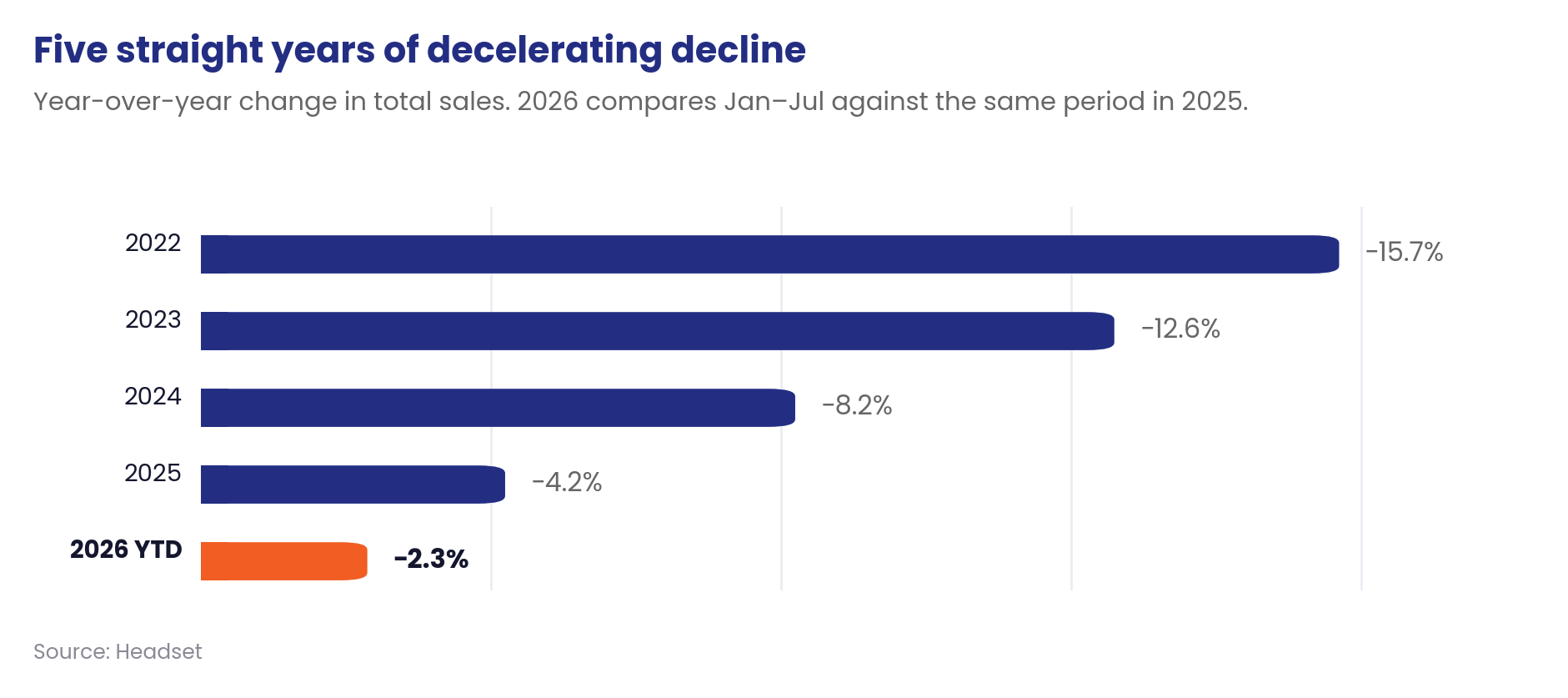
But the market is converging on its natural size. The rate of decline has compressed every single year, from -15.7% in 2022 to -2.3% through the first seven months of 2026, a smoother curve than Washington, Illinois, Michigan, or Nevada can claim. Discounting is the lowest in the mature West by a wide margin. Price deflation, still running everywhere, is running slower here than in any peer market. And roughly 15 points of market share have moved out of retailer house brands and onto third-party shelves since 2021, opening space that was effectively closed to outside brands for the better part of a decade.
Colorado is not a growth market. It's something more useful to a well-run operator: a stable, high-frequency, low-promotion market with identifiable white space and less competition than its size implies.
Methodology
Data for this report comes from real-time sales reporting by participating cannabis retailers via their point-of-sale systems, which are linked up with Headset's business intelligence software. Headset's data is very reliable, as it comes digitally direct from our partner retailers. However, the potential does exist for misreporting in the instance of duplicates, incorrectly classified products, inaccurate entry of products into point-of-sale systems, or even simple human error at the point of purchase. Thus, there is a slight margin of error to consider.
This report examines sales from US Headset Insights markets, including AZ, CA, CO, CT, IL, MA, MD, MI, MO, NJ, NV, NY, OH, OR, and WA. All figures are in USD. Year-over-year comparisons use January through July of each year so that 2026's partial-year data compares on a like-for-like basis. Basket-level metrics and package size detail are available from 2024 forward.
Key Takeaways
- Colorado's decline is nearly over. Sales fell 2.3% comparing January to July 2026 against the same period in 2025, following annual declines of 15.7%, 12.6%, 8.2%, and 4.2%. Five straight years of compression.
- Retailer house brands have fallen from 25.6% of the market in 2021 to 10.3% today. Third-party sales fell only 22% since 2021 against a total market decline of 35%, so the addressable market for an outside brand has shrunk far less than the market itself.
- Pre-rolls represent the clearest white space in Colorado. The category sits at 12.7% of sales, compared to 17.8% across the mature West, while category sales have grown 9.7% year over year, the fastest growth rate in the region.
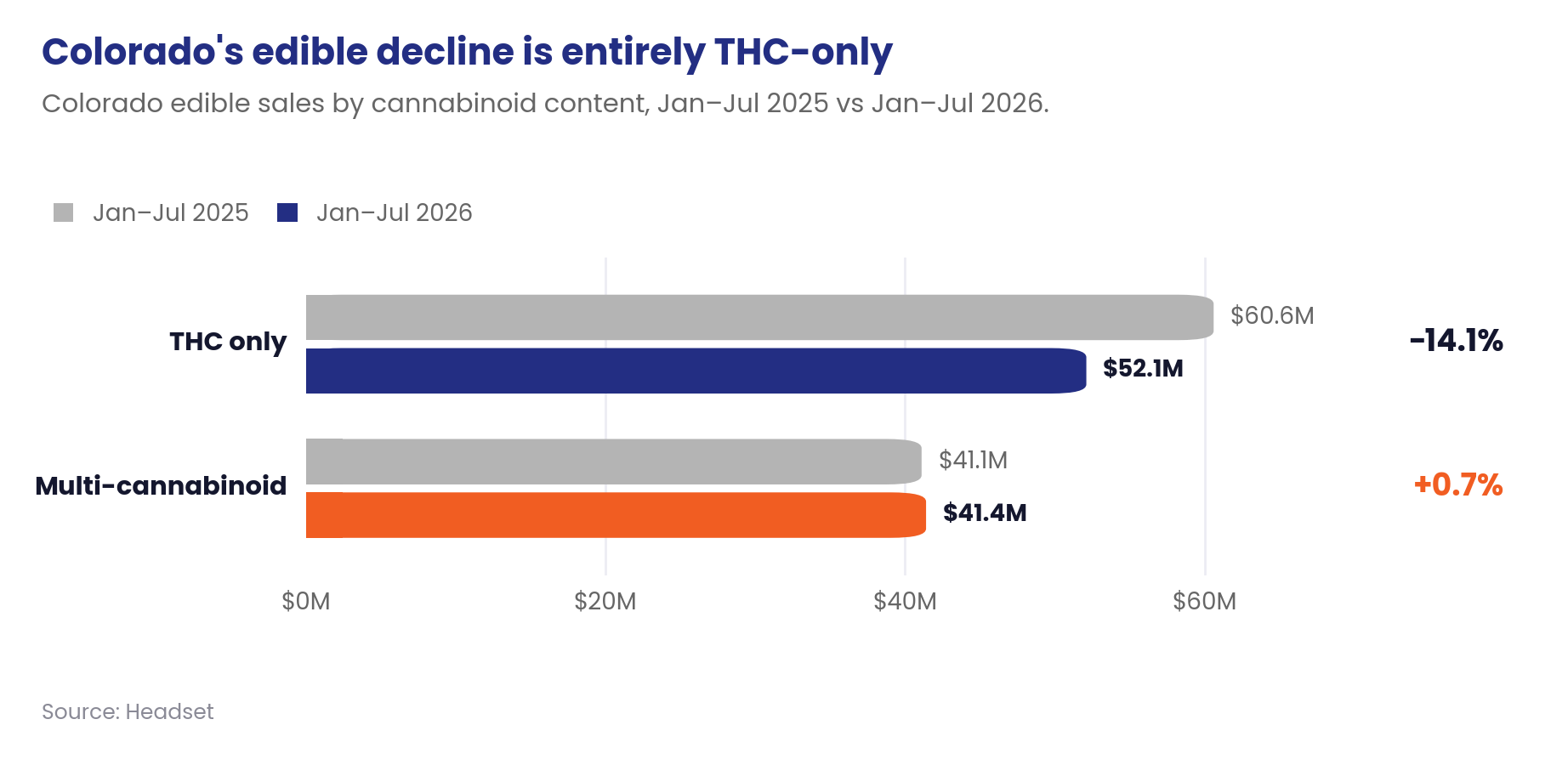
- Edibles over-index in Colorado at 13.9% of sales against 11.9% nationally, yet the category fell 8.1%. That decline is almost entirely THC-only product, down 14.1%. Multi-cannabinoid formulations grew 0.7% and now hold 44.3% of category sales, against Washington's 52.2%.
- Prices are still deflating, but slower here than anywhere in the mature West. Colorado flower is down 10.3% per gram since 2024 against California's 16.3%. Rising basket values come from format trade-up, not pricing power.
- Deli-style bulk flower is losing ground to pre-packaged formats. Bulk fell from 23.1% to 17.1% of flower dollars, while half-ounce packages climbed from 20.9% to 24.6%. The shift comes down to price per gram: larger formats simply cost less, pulling consumers toward bigger sizes.
- This is a young, high-frequency, low-promotion market. Millennials drive 44.4% of sales, consumers buy 2.9 items per visit (second only to Michigan), and the discount rate sits at 16% against Washington's 37.5%.
Sales Overview
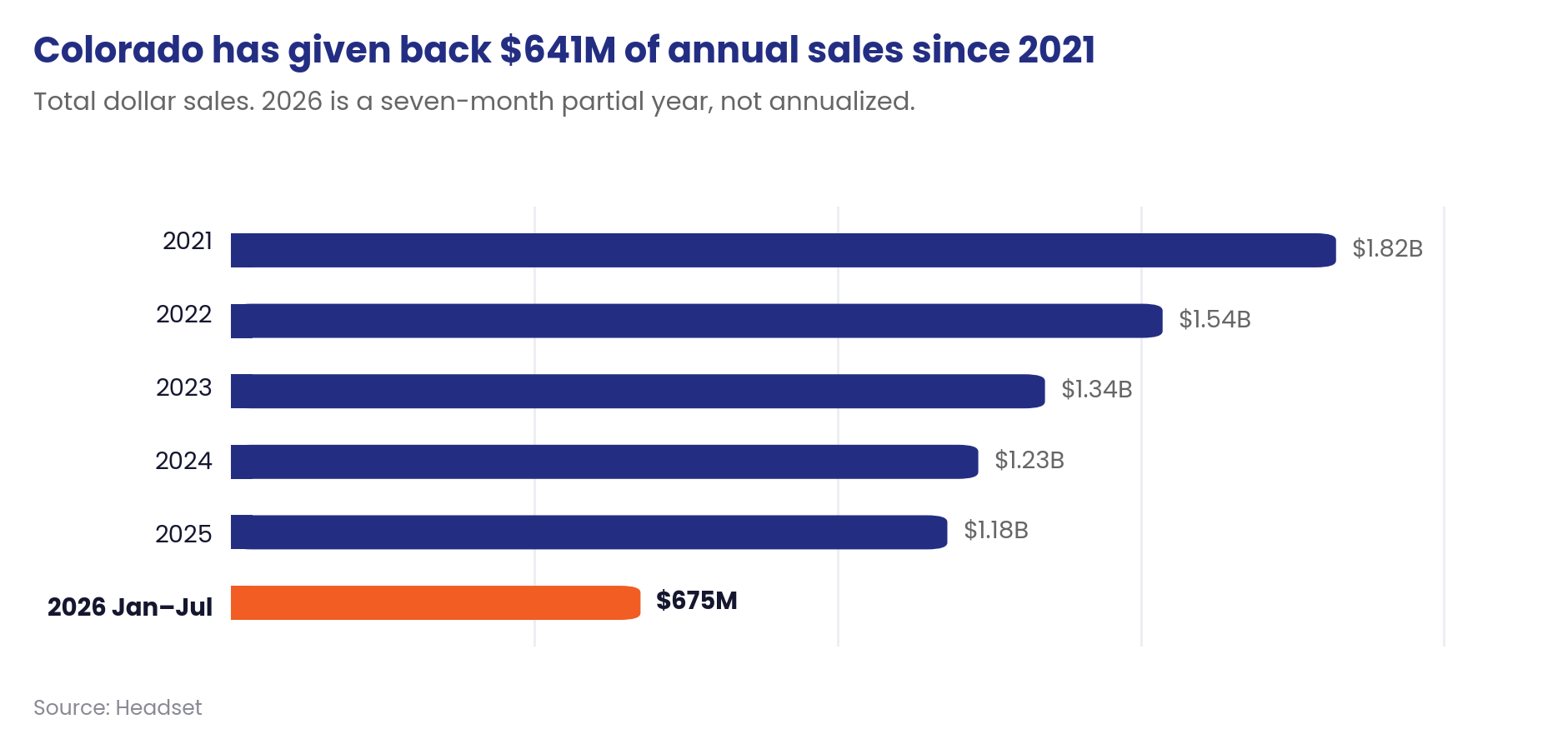
Colorado has given back $641M of annual sales since the pandemic peak in 2021, a 35% decline. Stated that way, it sounds like a market in trouble. But the decline has gotten smaller every single year without exception. Five consecutive years of compression is not noise. It's a market converging on its natural size.
Month-level data confirms it. Every month of 2026 has landed between -1.1% and -3.7% against its 2025 counterpart, with no acceleration and no sign of a second leg down. The floor is close enough to plan around.
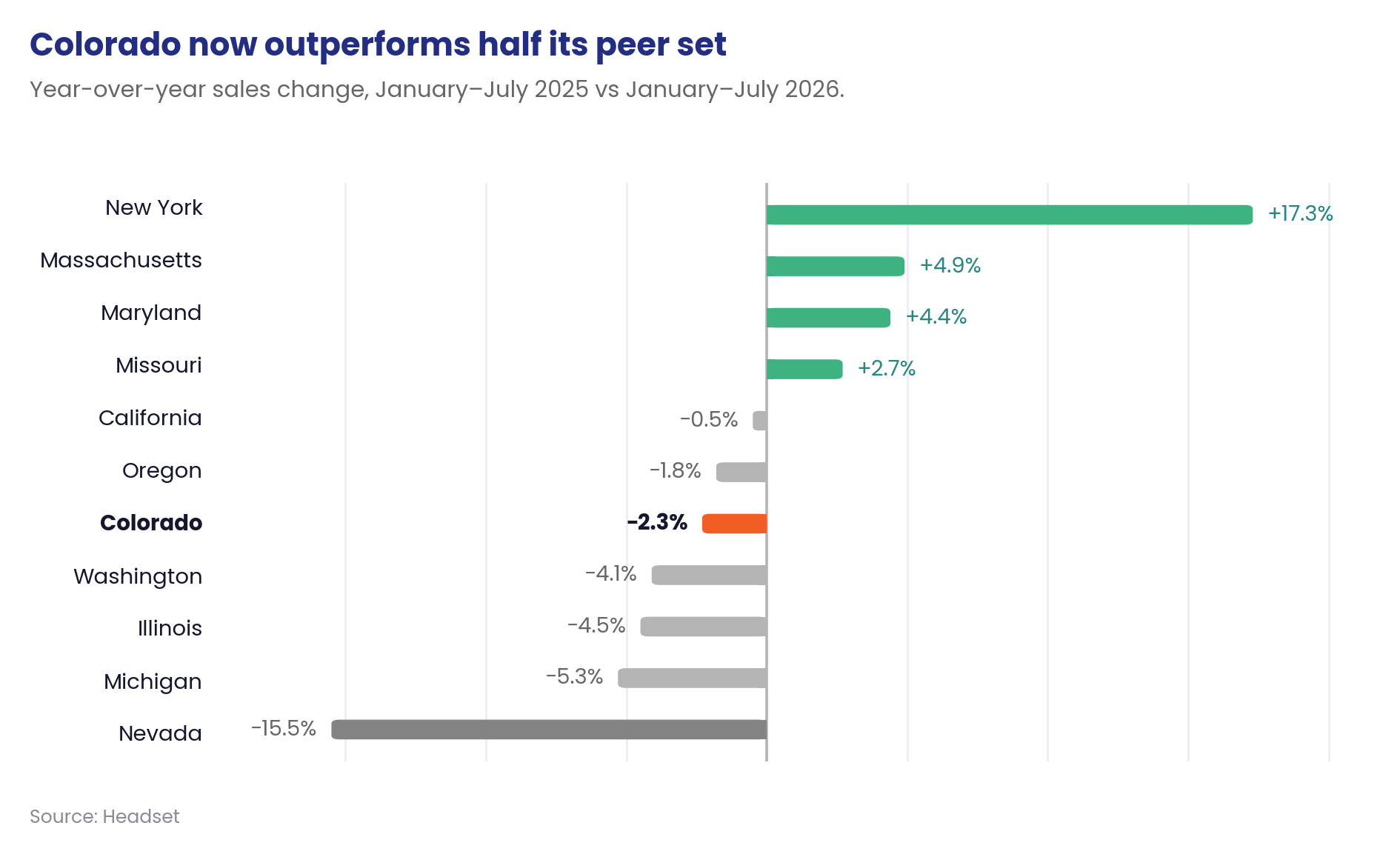
Here's the part that reframes Colorado entirely. Among the mature Western markets, Colorado is now outperforming Washington and Nevada and sitting within striking distance of California and Oregon. Michigan, the market everyone points to as the growth story of the decade, declined more than twice as fast as Colorado this year. Colorado went through its correction early. Some of its peers are going through theirs now.
Top Brands
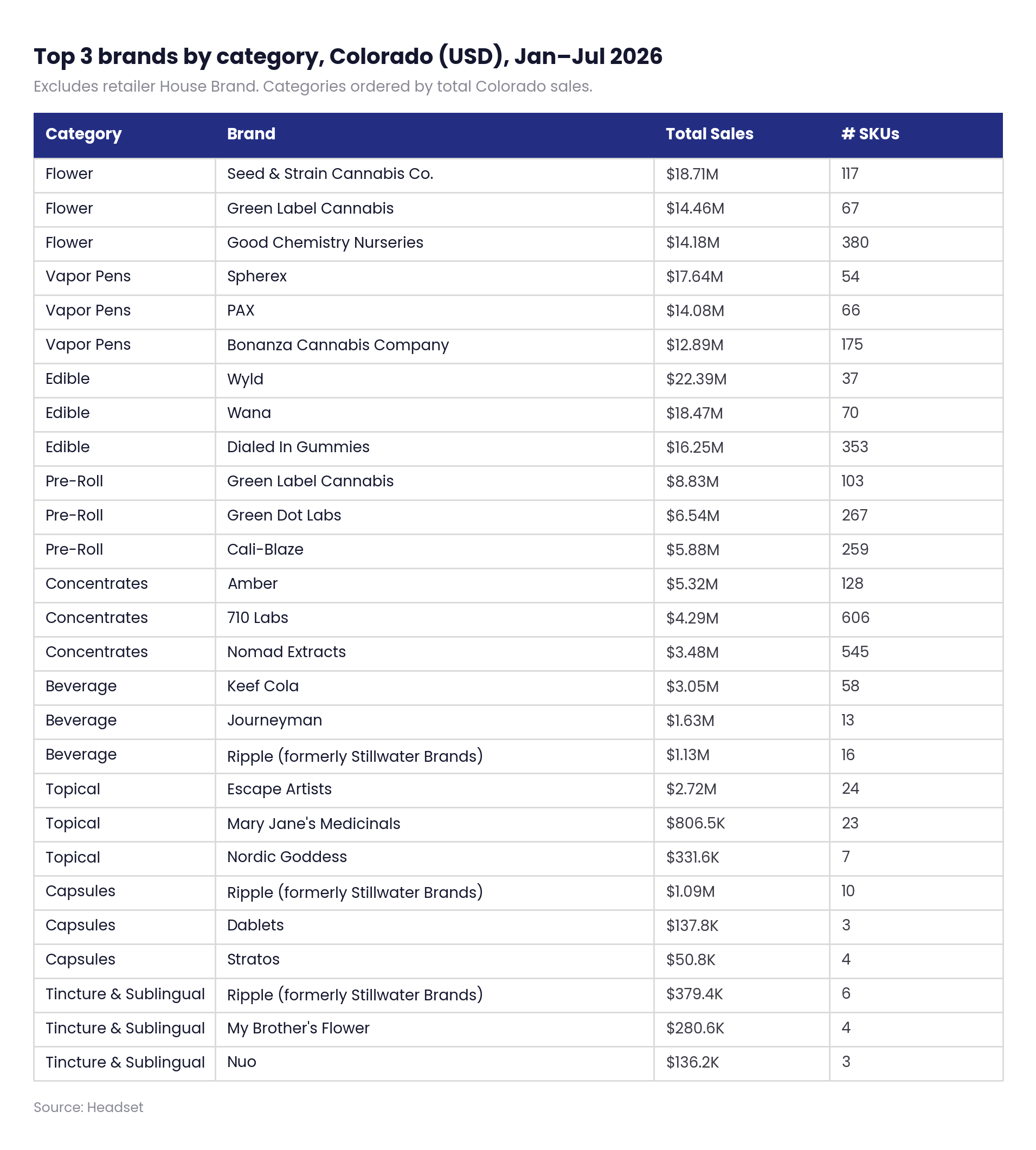
Category Assortment
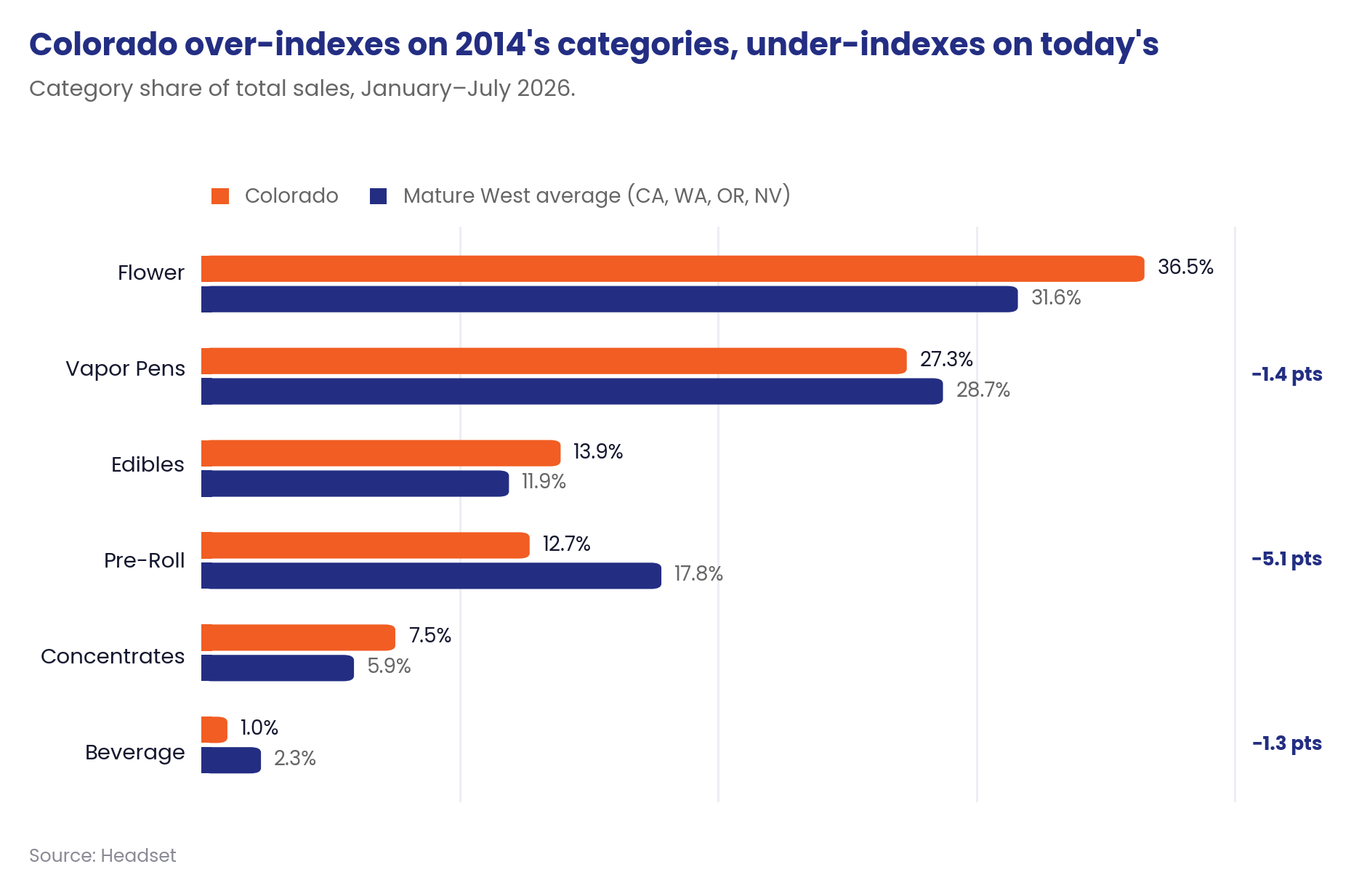
Everywhere else in the country, flower is giving up share to vapes and pre-rolls. Colorado hasn't gotten the memo. It over-indexes on flower, edibles, and concentrates, the three categories that defined cannabis retail in 2014, and under-indexes on the two that have defined it since 2020. Its 12.7% pre-roll share is the lowest in the mature West, and nationally only Maryland runs a thinner pre-roll category.
That's what a market shaped by the habits of the longest-tenured consumer base in the country looks like. It's also where the opportunity is hiding: these aren't categories this consumer dislikes. They're categories nobody has properly sold them on.
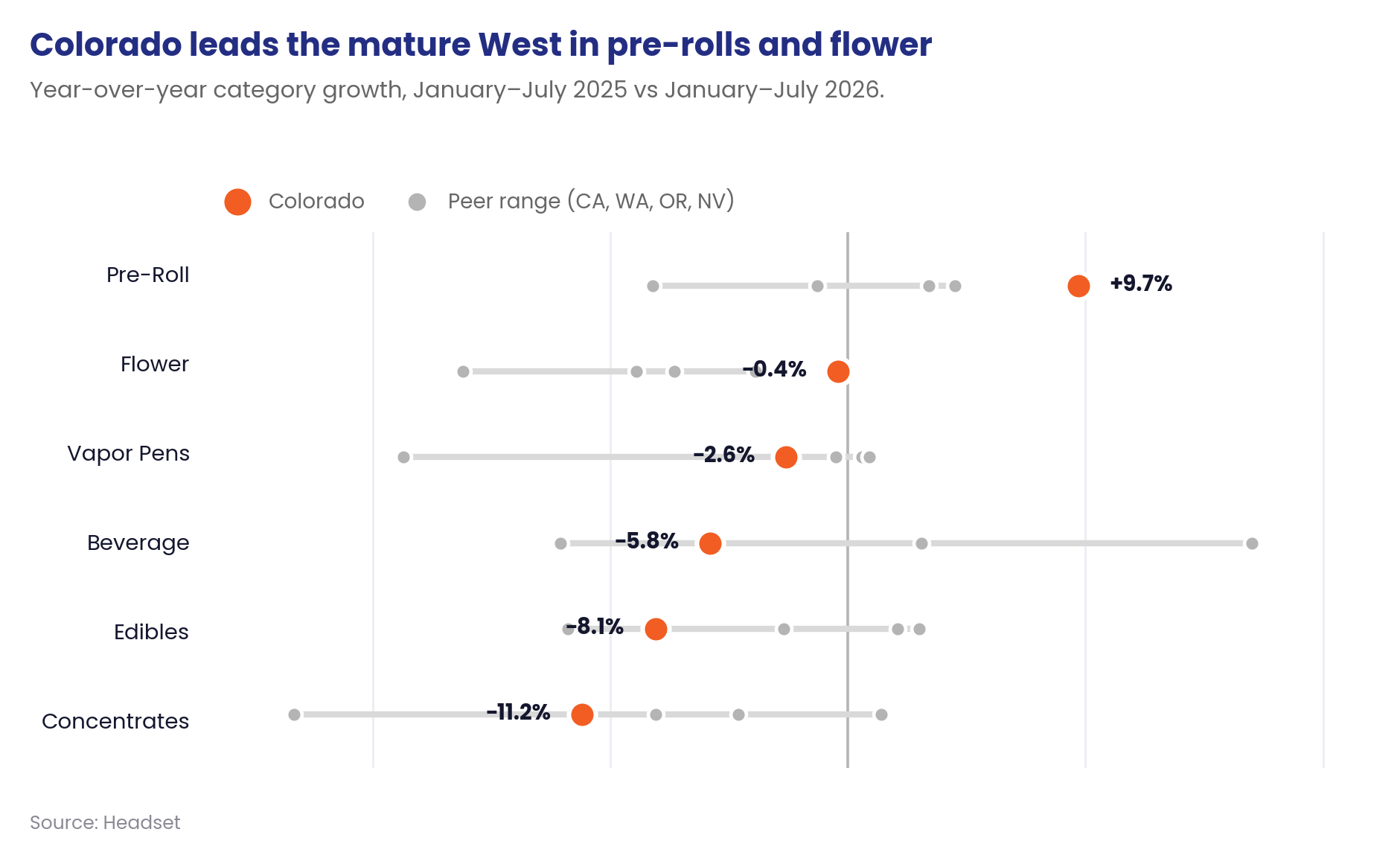
Two findings matter more than the rest. Colorado's pre-roll growth of 9.7% is the fastest in the mature West, more than double California's. The most under-penetrated pre-roll market in the country is also the fastest-growing one, and that combination won't last. Colorado flower, meanwhile, is essentially flat at -0.4% while every peer sheds between 3.9% and 16.2%.
Where the White Space Is
Pre-Roll
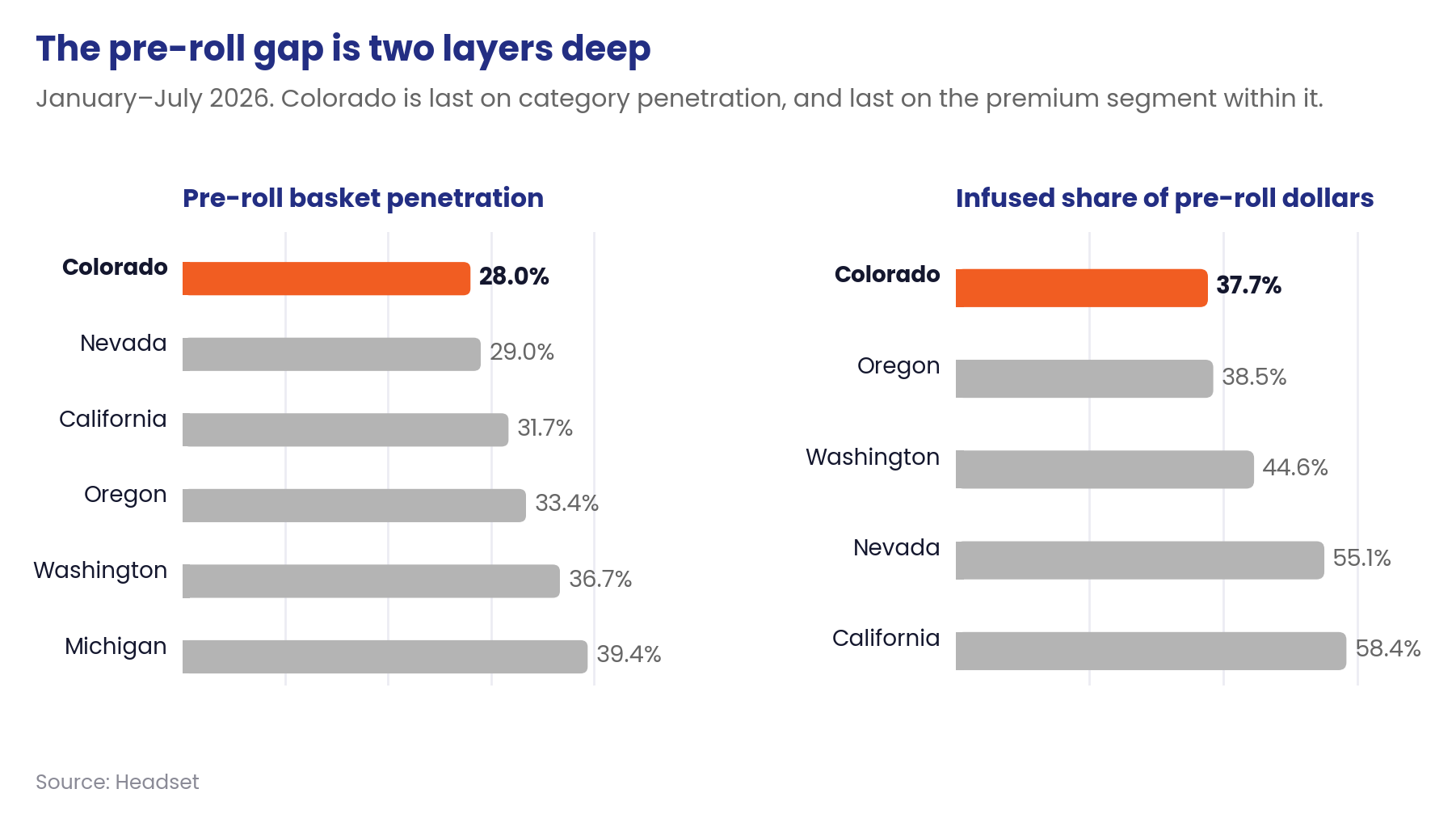
Colorado has the mature West's lowest pre-roll basket penetration at 28%, nearly nine points behind Washington, and infused pre-rolls are just 37.7% of category dollars against California's 58.4%. The gap runs two layers deep. Yet the category grew 9.7% this year, the fastest in the region, while total brand count fell from 182 to 146. Almost all of that attrition sits in the long tail: brands doing more than $100k in pre-roll sales only moved from 82 to 79. The serious field held steady while the category grew, lifting revenue per established brand 13.9%, from roughly $955k to $1.09M. That combination is one of Colorado's biggest opportunities.
Lifting Colorado to the peer-average share would shift roughly $58M of annualized spend into pre-rolls, mostly reallocated from other categories rather than new growth. Read it as the size of the prize, not market expansion.
Edibles
Edibles over-index in Colorado, at 13.9% of sales against 11.9% nationally, and the category is heavily concentrated in gummies at 88.6% of dollars. Even so, it fell 8.1% year over year.
A closer look shows that decline is almost entirely THC-only product, which still accounts for 55.7% of category sales and fell 14.1%. Multi-cannabinoid formulations are the ones showing appeal, outperforming the category with +0.7% growth in total sales and rising to 44.3% of edible sales. In a contracting market and a contracting category, that's a sign of strength.
Edibles have broad demographic appeal, with recreational and wellness demand overlapping, and effects-driven formulation is what that consumer is buying.
CBN, CBG, and CBD are the three largest additions by sales, at $19.6M, $10.5M, and $9.7M, though only CBN and CBG are holding or gaining. CBD alone is down 10.6%, so the simple CBD-and-THC blend already looks well served.
The Shelf Is Opening
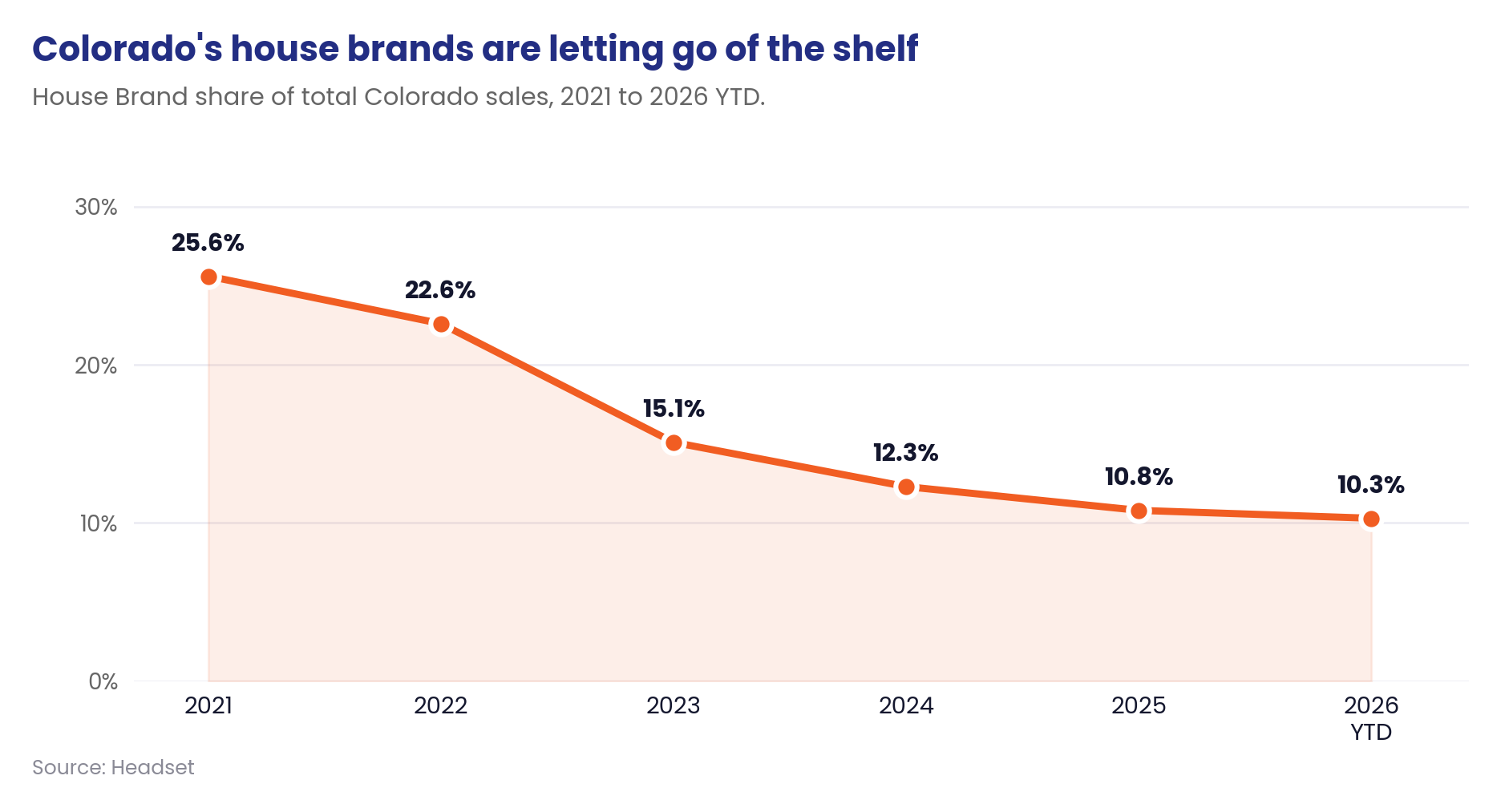
Colorado required vertical integration in its early years, and the culture outlasted the rule. In 2021, retailer house brands were more than a quarter of everything sold in the state. Today they're a tenth.
That's roughly 15 points of market share, over $100M in annual sales, moving from retailer-owned product onto third-party shelves in five years. While the total Colorado market fell 35% between 2021 and 2025, sales of branded third-party product fell only 22%, from $1.36B to $1.05B. Declining vertically integrated brands represent a clear opportunity for independent brands in the state.
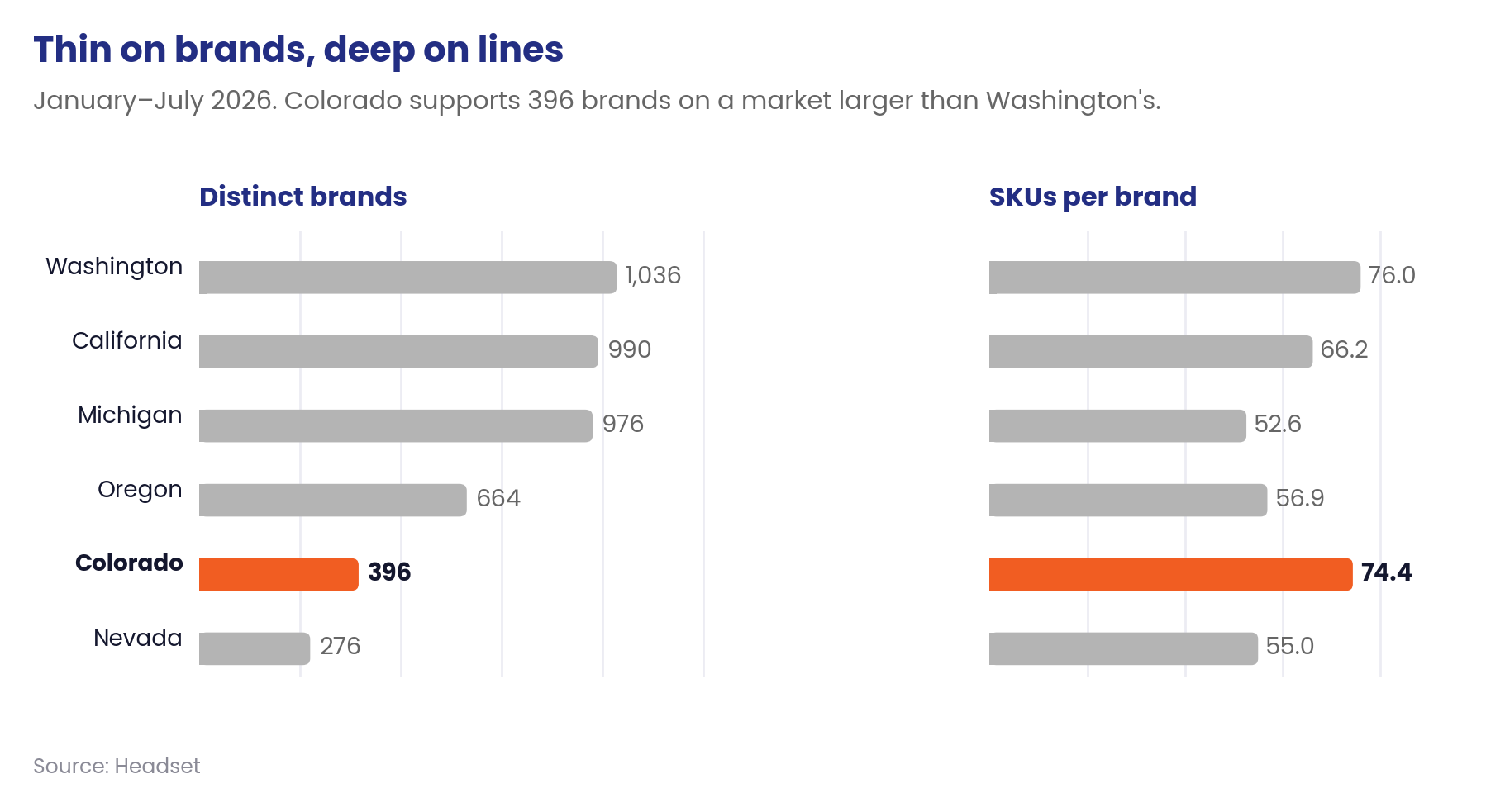
Colorado supports 396 brands against Washington's 1,036, on a market that's slightly larger in dollar terms. But the brands that are here run deep lines at 74.4 SKUs each, second only to Washington, a legacy of the vertical integration era when operators built complete catalogs for their own shelves. Colorado isn't a market you win with one hero SKU and a good story. It rewards a full line, multiple price tiers, and format coverage across sizes.
It's also the most concentrated market in the mature West, with the top five brands taking 24.9% of sales and the top ten taking 37.1%. Displacing an incumbent is harder here, but the target list is short and knowable.
Pricing
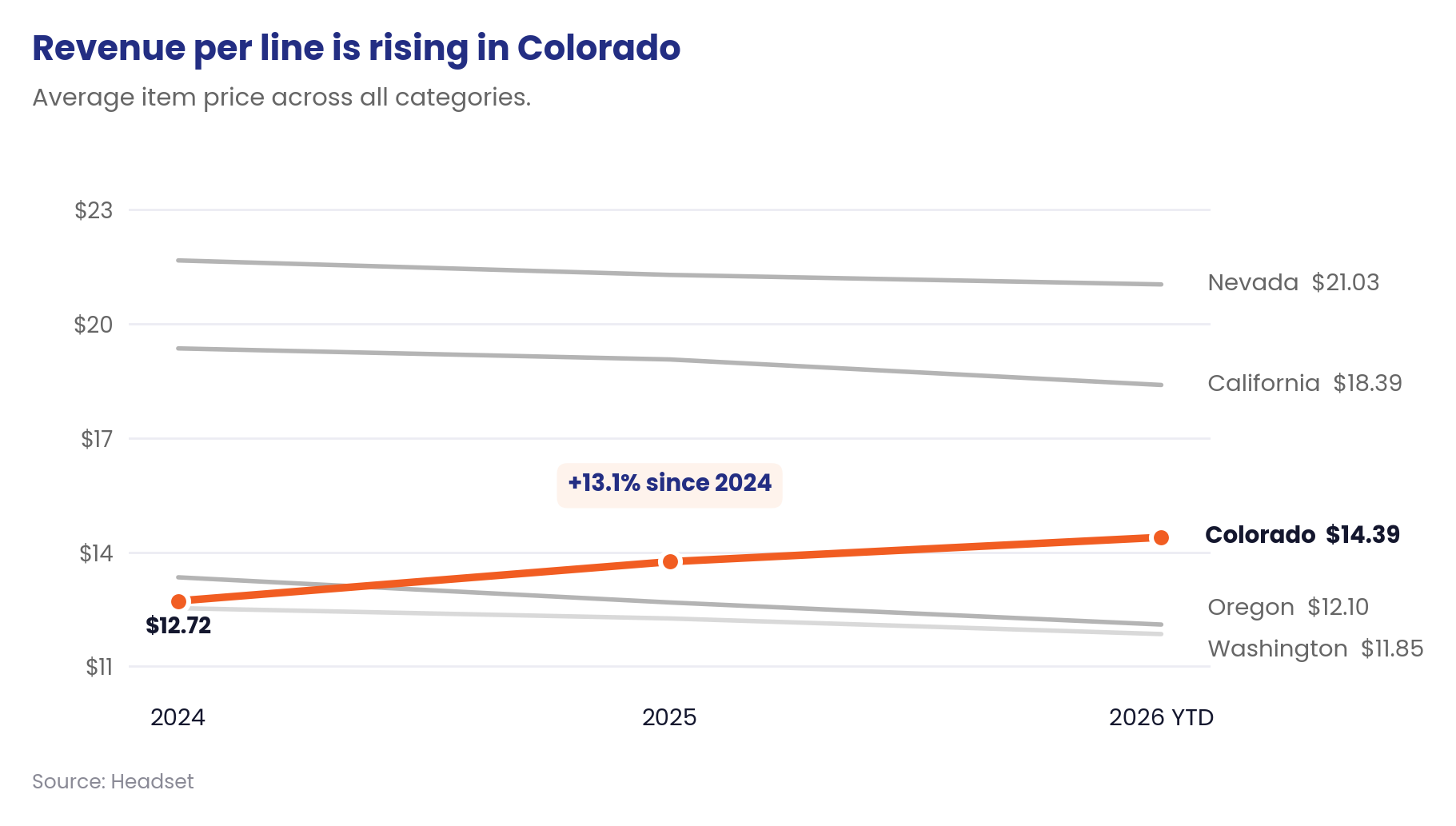
Average item price is rising in Colorado and falling in every peer market. That's real, and it's why revenue has stabilized while units haven't: dollars fell 2.3% this year while units fell 8.8%.
But average item price isn't the price of cannabis. It's the price of a line on a receipt. Measure the price of the product itself, per gram and per milligram, and Colorado is still deflating.
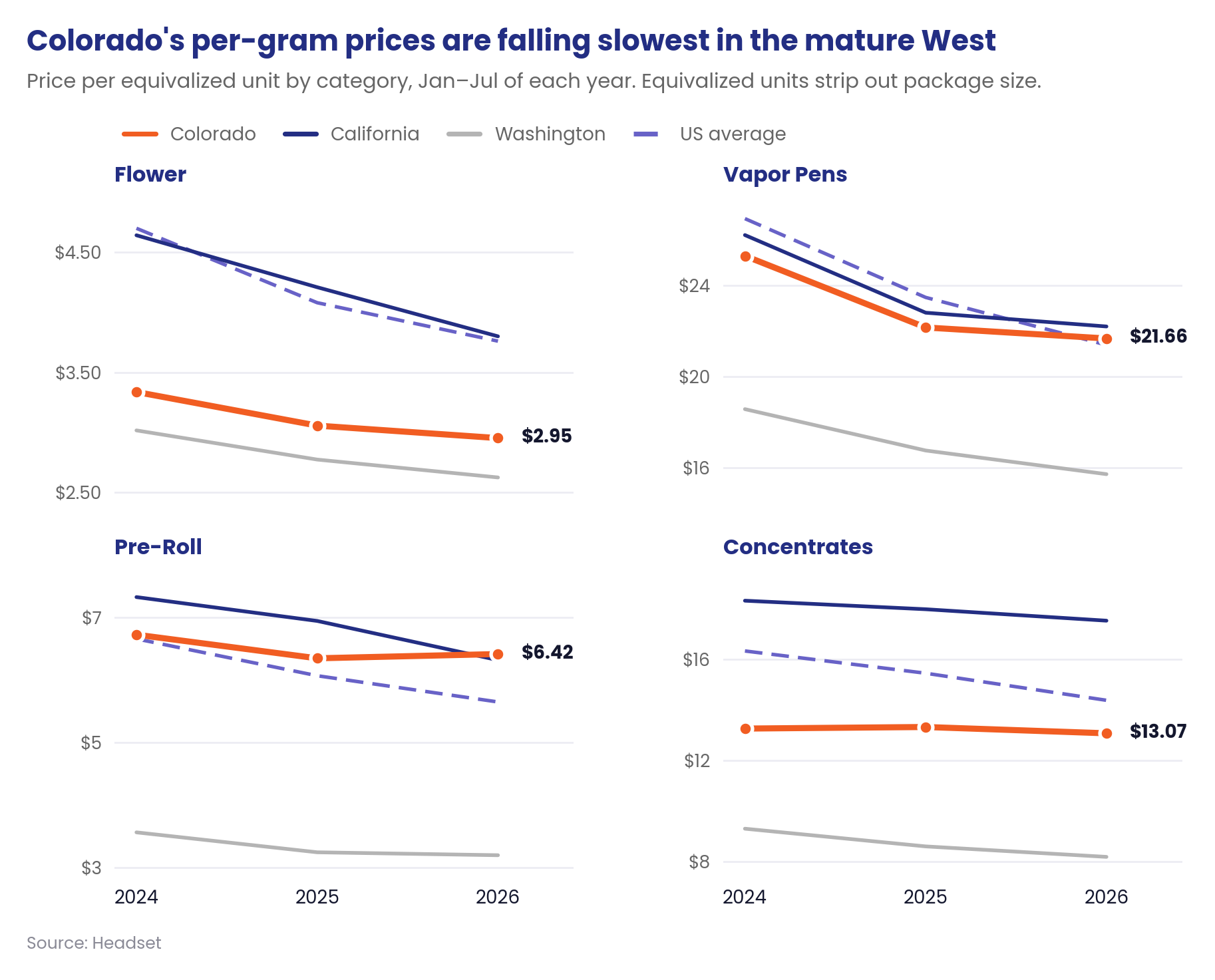
The gap between those two tables is entirely format. Consumers are trading up into larger packages that cost more per transaction and less per gram. A half-ounce rings at roughly $27 where an eighth rings at $16, so the item price climbs while the price of what's in the bag falls.
What's genuinely distinctive about Colorado isn't that prices have turned. It's that Colorado's deflation is now the slowest in the mature West across every major category, and concentrates are the only category in any of these three markets to tick upward. After leading the region into price compression, Colorado is leading it out.
For anyone modeling this market, the practical implications are specific. Revenue per basket is stabilizing, and that's durable. Gross margin expansion from pricing isn't supported by this data. Dollar growth here comes from mix and format, not from volume or from price.
Discounting
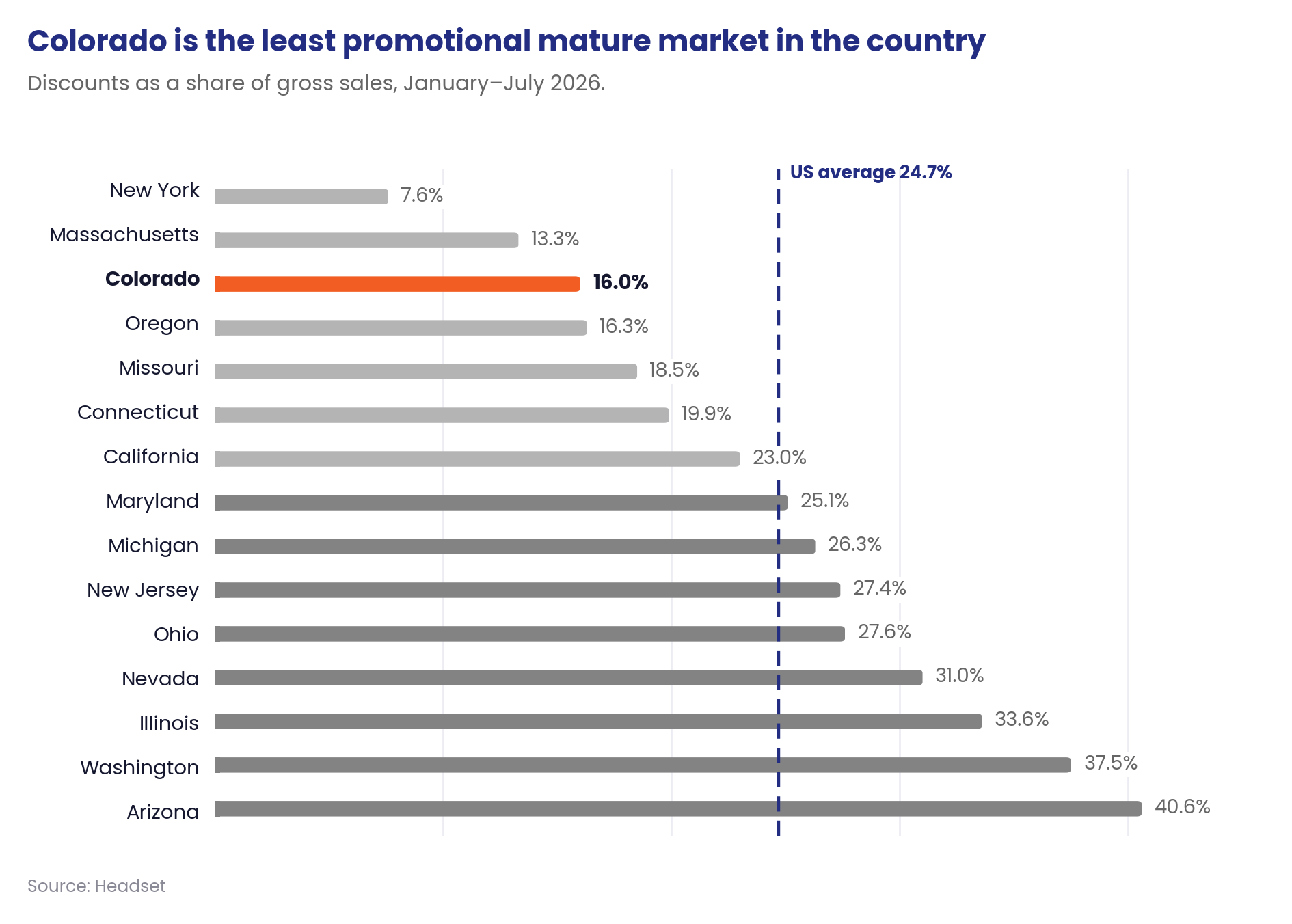
Colorado retailers give away 16.0% of gross to discounts against a US average of 24.7%. Only New York at 7.6% and Massachusetts at 13.3% run leaner, and both are young markets that haven't yet had to compete hard on price. Among mature markets, Colorado is the least promotional in the country.
The spread at the top end is severe. Arizona discounts at 40.6%, Washington at 37.5%, Illinois at 33.6%. Washington and Nevada are Colorado's closest peers in age and region, and both give away roughly twice as much of every dollar.
That gap is worth real money. Holding gross constant, Colorado retailers kept about $70M more in net revenue over seven months than they would have at the national discount rate, roughly $120M annualized.
This is the clearest structural positive in the market. Colorado corrected through price deflation rather than through promotion, so its margin structure came out of the contraction intact. Discounting has crept up from 14.5% in 2024, so pressure is real, but from this starting point there's room to move before promotion begins destroying economics.
Package Size
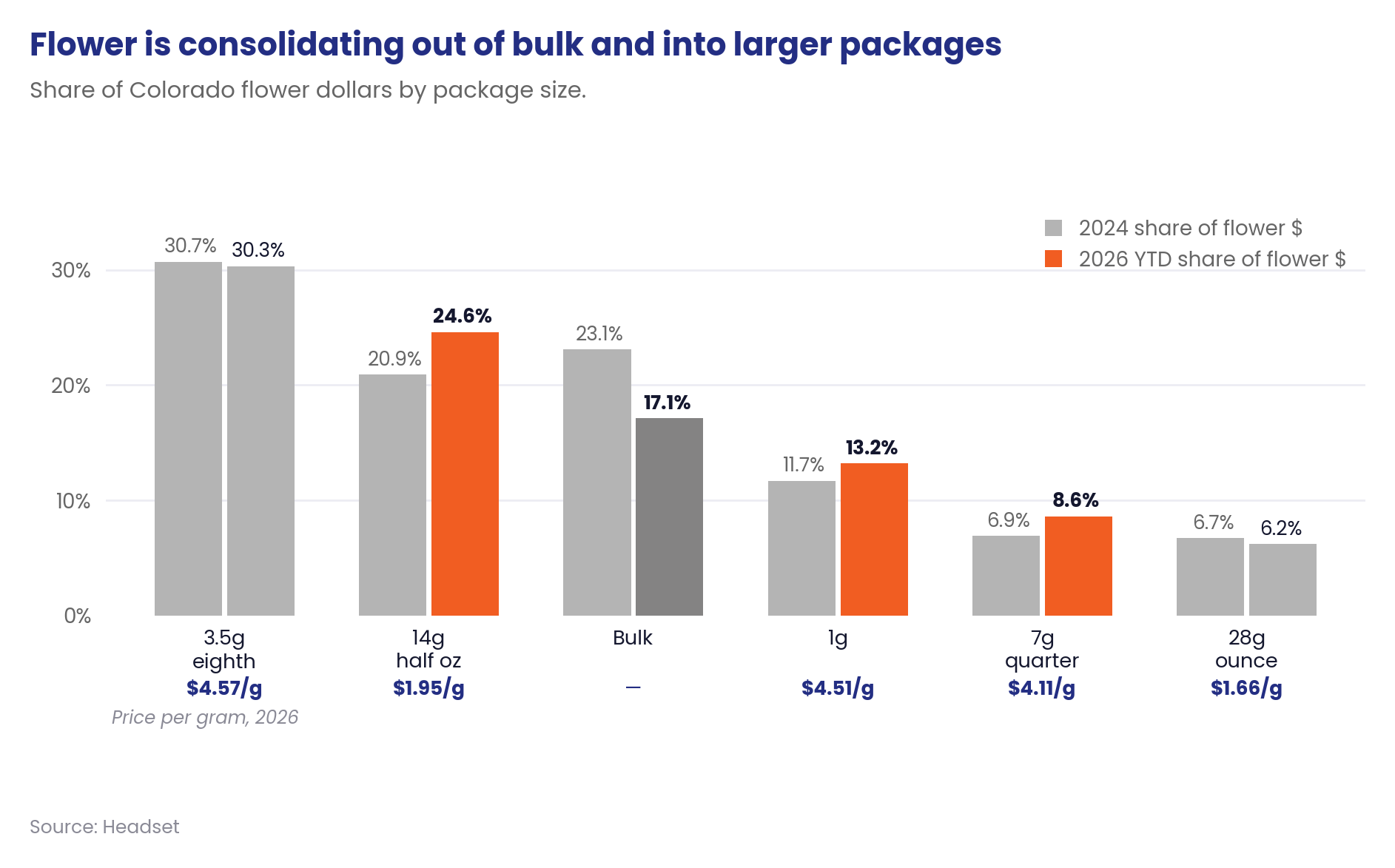
Two migrations are running at once. Bulk flower is losing share steadily, down six points in two years, as retailers move from deli-style loose product to pre-packaged inventory. Bulk fell 32.7% in units while its dollars fell about 15%, which is what package consolidation looks like in the data rather than a collapse in consumption, and it accounts for most of the market's unit decline.
Within pre-packaged flower, consumers are trading up in size. The per-gram column explains why. Colorado flower has split into two price ladders with a cliff between them: 3.5g and 7g sell at $4.07 to $4.45 per gram, while 14g and 28g sell at $1.86 to $1.96. That's a 2.4x spread, wide enough that any price-aware consumer who can afford the larger up-front spend makes the jump.
For brands, the read is direct. The 14g tier is where Colorado's flower volume is going, and it's a value-grade fight. The 3.5g and 7g tiers are where premium flower still commands over $4 per gram. Competing on premium positioning inside the 14g tier means fighting the format's economics.
Conclusion
Colorado's market has spent five years contracting, but the decline has compressed for five consecutive years running and now sits at roughly 2%, outperforming peers like Washington. Deflation is slower here than in any peer market, and discounting is the lowest in the region by a factor of two. The retailer house brands that owned a quarter of the shelf in 2021 now own a tenth, transferring more share to third-party brands than any other mature market has on offer.
None of that makes Colorado a growth story. Units are still falling, the consumer base isn't expanding, prices per gram are still declining, and dollar gains have to come from shifts in product mix. What Colorado offers instead is a market where the hard part has already happened, where the field is thinner than its size suggests, and where its most under-penetrated large category is also its fastest growing.
For brands, the lane is infused pre-rolls and diversified edibles. For retailers, it's the seven in ten baskets that contain no pre-roll. For investors, it's a stabilizing revenue base and the region's lowest promotional load, in a state still priced on the 2022 narrative, with the caveat that pricing won't do the work.
Colorado went first, and it corrected first. With Michigan, Illinois, and Nevada all contracting faster today, it remains a bellwether, and the operators who learn this market now will recognize the pattern when their other markets get here.
Go deeper on the data
