.svg)

Aug-2026
Sales
Trend
6-Month
Product Count
SKUs
Avg Price
YoY Sales Change
YoY Price Change


Where to Buy
Temple is stocked at 35 licensed dispensaries across Maryland and Michigan, 23 of them in Maryland, with the deepest coverage in Columbia, Annapolis, Baltimore, Pikesville, and Capitol Heights. Search by ZIP code or city below to find the closest one.
Market Insights Snapshot
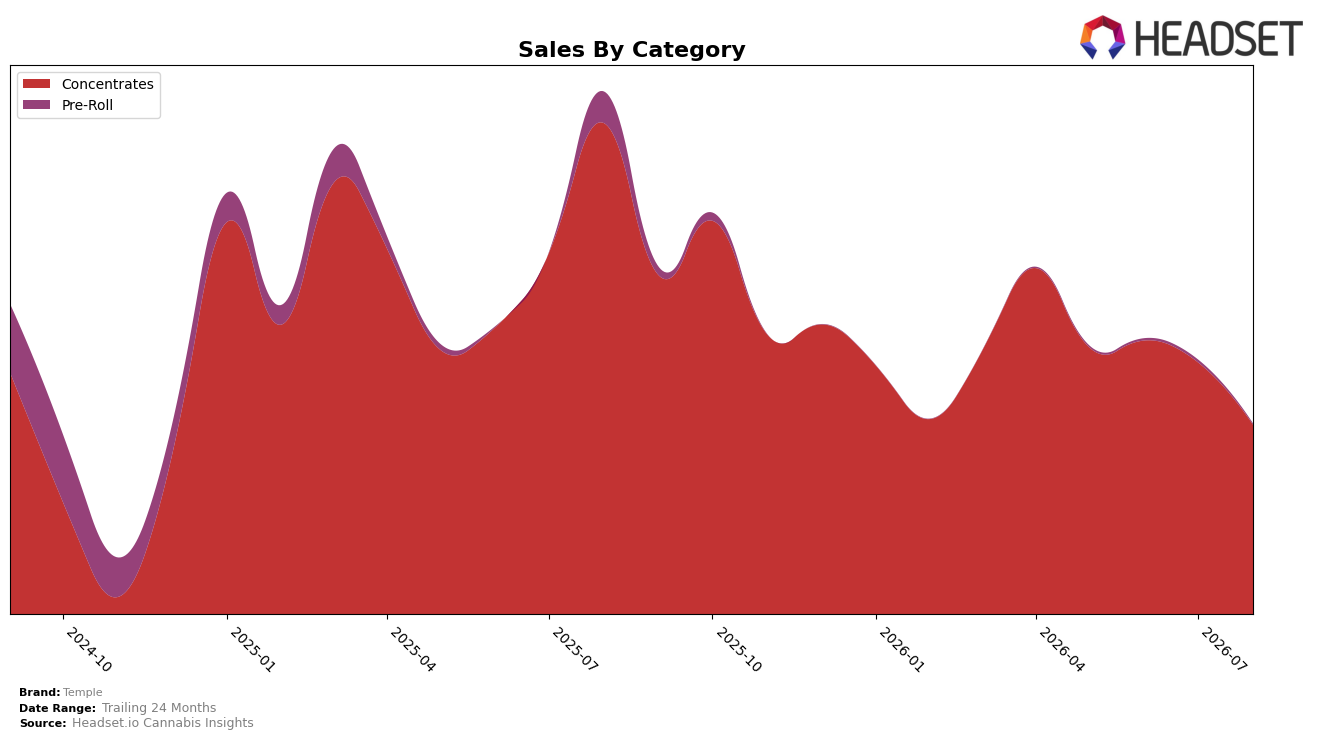
Temple’s mix in August 2026 is concentrated, with Concentrates at 99.51% share and Pre-Roll at 0.49%. Within that mix, Concentrates declined 61.46% year over year and 24.84% month over month, while Pre-Roll fell 97.01% year over year and 62.06% month over month, indicating that diversification is shrinking rather than absorbing volatility. Average price dipped 0.11% year over year to $45.44, and brand sales declined 63.59% year over year, pointing to volume contraction rather than price pressure as the primary drag. The pattern implies a product strategy anchored to a single category is amplifying downside exposure, as both the dominant category’s double‑digit month-over-month slide and the near-elimination of the minor category reduce resilience to demand swings.
Positioning-wise, Temple’s 99.51% reliance on Concentrates alongside a 24.84% month-over-month retreat suggests the brand is over-indexed to a demand pocket with high short-term variance, while the 97.01% year-over-year collapse in Pre-Roll removes a buffer for trial and cross-sell. In Maryland Concentrates, Temple sits at rank 26, and the 61.46% year-over-year drop within the lead category coupled with a 0.49% share allocation to Pre-Roll indicates limited laddering opportunities within adjacent forms. The implication is that, absent a reallocation from a 99.51% single-category stance, maintaining or improving a rank in a concentrated segment will be constrained by exposure to category-specific slowdowns.
Competitive Landscape
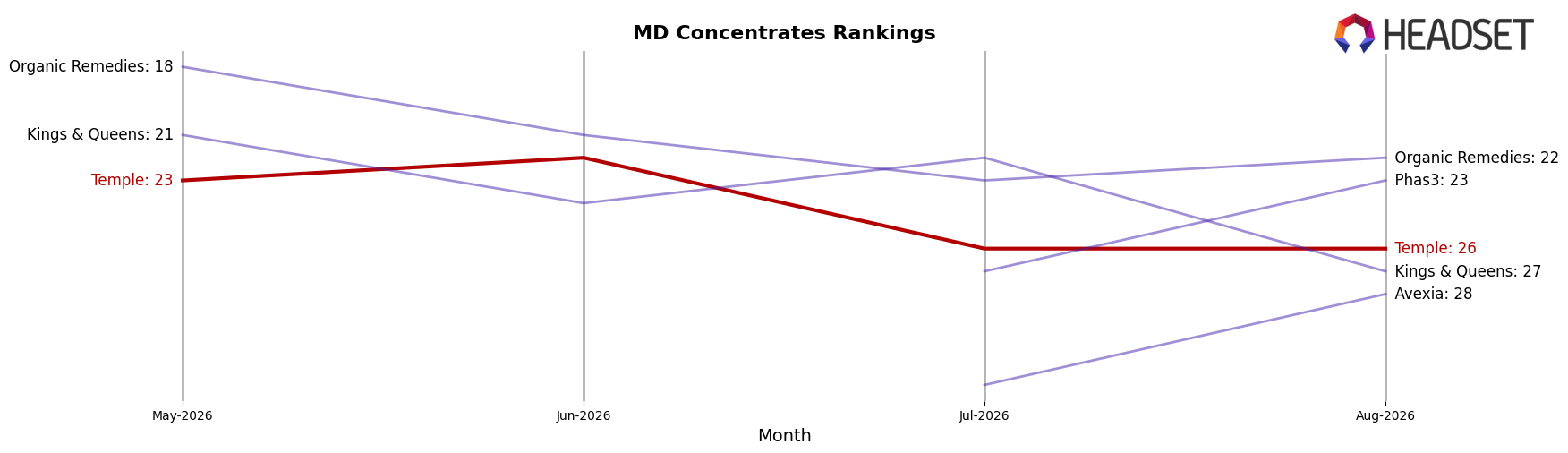
Temple ranks #26 in MD Concentrates in August 2026, down 9 positions year over year from #17, and 3 spots lower than May 2026 when it held #23; by contrast, District Cannabis held #1 both this year and last while growing sales by 42.9%, and Grassroots improved from #3 to #2 with 25.0% year-over-year growth. Temple’s peak rank of #17 in August 2025 versus the current #26, alongside top-tier competitors advancing or holding positions, implies that Temple’s trajectory is slipping toward the middle-to-lower tier unless rank recovery reappears within the next one to two quarters.
Notable Products
Stanky Leg Nepalese Hash Ball (1g) delivered the standout move in August 2026 with a +147.9% month-over-month surge to $6,554 while climbing to rank 1, outpacing steep pullbacks like White 99 Temple Ball Hash (1g) at -78.9% and Super Skunk Nepalese Hash Ball (1g) at -59.5%. Across the top ten, declines of -31.2% for Gush Mintz Temple Ball Hash (1g) and -56.4% for Candy Fumez Temple Ball Hash (3.5g) contrasted with a single breakout, and eight of the top ten are Concentrates, indicating a category-heavy portfolio despite mixed SKU trajectories. Bravado Nepalese Hash Ball (1g) fell -47.3% into rank 2 while Gushmints Temple Ball Hash (1g) slipped -16.7% to rank 3, and the Pre-Roll entry Midnight Munch Hash Infused Pre-Roll 2-Pack (1g) dropped -62.0% at rank 10. The pattern implies Temple’s commercial direction is consolidating around a few winning Concentrates SKUs while culling or repositioning lagging hash variants to stabilize category share.
Top Selling Cannabis Brands





Data for this report comes from real-time sales reporting by participating cannabis retailers via their point-of-sale systems, which are linked up with Headset’s business intelligence software. Headset’s data is very reliable, as it comes digitally direct from our partner retailers. However, the potential does exist for misreporting in the instance of duplicates, incorrectly classified products, inaccurate entry of products into point-of-sale systems, or even simple human error at the point of purchase. Thus, there is a slight margin of error to consider. Brands listed on this page are ranked in the top twenty within the market and product category by total retail sales volume.

