.svg)


Market Insights Snapshot
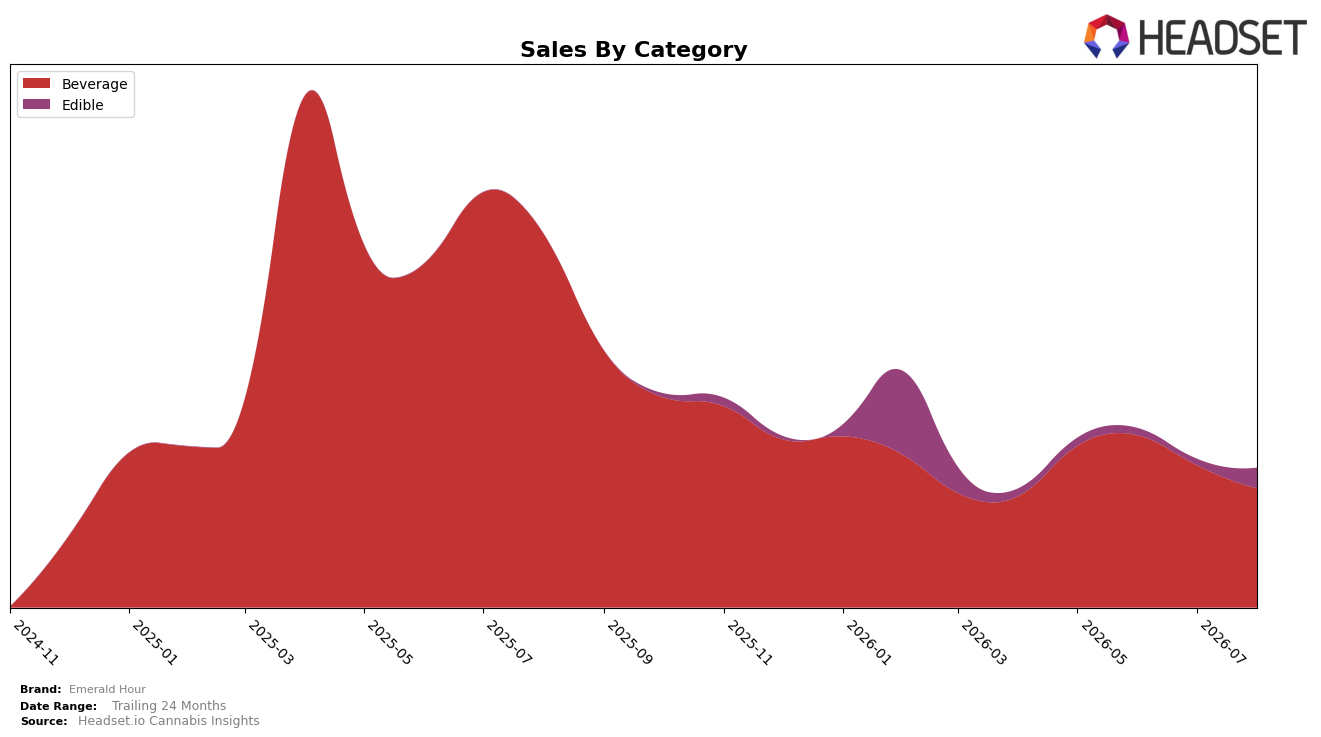
Emerald Hour concentrated 85.27% of August 2026 sales in Beverage while Edible expanded to 14.73% share, a mix shift driven by Beverage’s -68.21% year-over-year and -16.51% month-over-month declines against Edible’s 241.66% month-over-month surge from a low base and an undefined year-over-year. With average prices down 12.99% year-over-year to $7.28 and Beverage pricing at $7.32 versus Edible at $7.04, the brand is leaning into lower-priced formats as volume in its core erodes, implying that August 2026 was a pivot month where reliance on Beverage weakened and Edible acted as a tactical buffer.
Category concentration softened as Beverage’s share slipped alongside a -16.51% month-over-month contraction while Edible jumped 241.66% month-over-month, indicating that Emerald Hour is migrating from a single-category identity to a two-format footprint. Holding an Ontario Beverage rank of 28 while Beverage fell -68.21% year-over-year places the brand in a middle-of-pack slot dependent on stabilizing its core, suggesting that future positioning will hinge on balancing Beverage recovery with targeted Edible investment to protect share and maintain visibility in Ontario.
Competitive Landscape
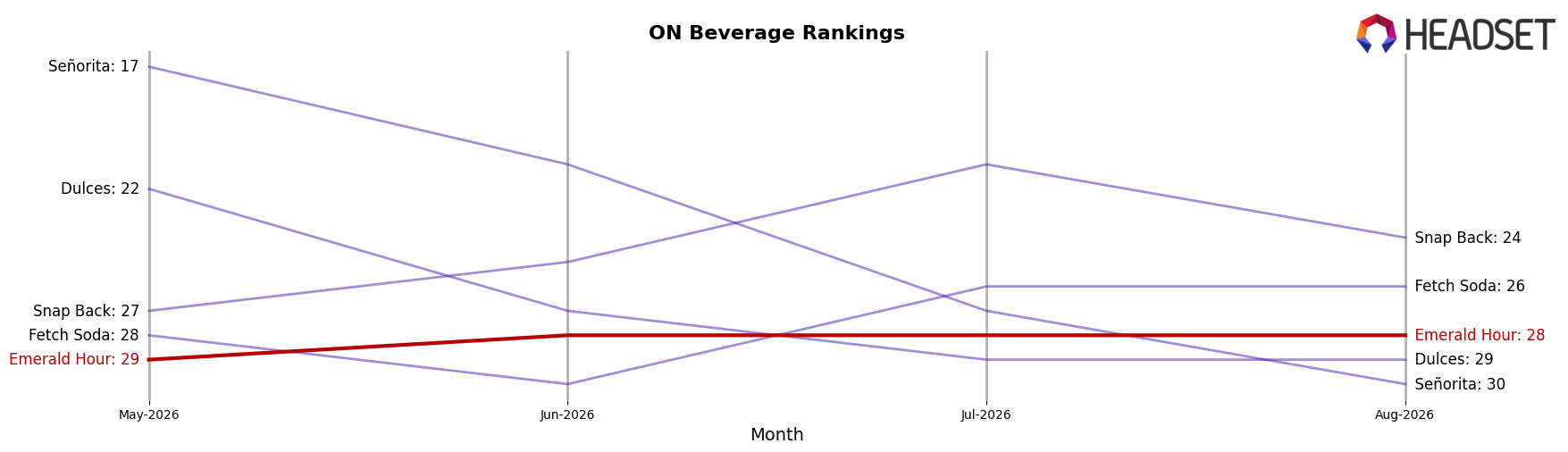
Emerald Hour sits at rank #28 in ON Beverage for August 2026, down 5 positions year over year from #23 and up 1 place versus the last three months from #29, while its historical peak was #21 in July 2025 and current placement trails that by 7 spots; in the same period, XMG held #1 with a -31.4% YoY sales change but no rank movement from #1, and Versus improved from #3 to #2 with +7.0% YoY growth, indicating that Emerald Hour’s slippage against top-tier brands that are either maintaining top ranks despite contraction or climbing with modest growth implies a gradual erosion of competitive position that will likely persist without a catalyst to regain share.
Notable Products
Peach White Grape Live Rosin Gummies 2-Pack (10mg) posted the standout move in August 2026 with a +241.48% month-over-month surge to rank 3, while Cranberry Citrus Live Rosin Soda (10mg THC, 222ml) fell 33.65% yet held rank 1. Agave Lime Sea Salt Live Rosin Soda (10mg THC, 222ml) rose 26.45% at rank 2, contrasted by Ginger Lime Soda (10mg THC, 222ml) dropping 36.12% at rank 5. Four of the top five SKUs are Beverages, but the single highest growth rate came from an Edible, implying a tilt toward trial-driven diversification beyond sodas.
Top Selling Cannabis Brands




Data for this report comes from real-time sales reporting by participating cannabis retailers via their point-of-sale systems, which are linked up with Headset’s business intelligence software. Headset’s data is very reliable, as it comes digitally direct from our partner retailers. However, the potential does exist for misreporting in the instance of duplicates, incorrectly classified products, inaccurate entry of products into point-of-sale systems, or even simple human error at the point of purchase. Thus, there is a slight margin of error to consider. Brands listed on this page are ranked in the top twenty within the market and product category by total retail sales volume.

