.svg)


Where to Buy
Happy Fruit is stocked at 124 licensed dispensaries across California and Oklahoma, 121 of them in California, with the deepest coverage in Los Angeles, Sacramento, San Diego, Fresno, and La Mesa. Search by ZIP code or city below to find the closest one.
Market Insights Snapshot
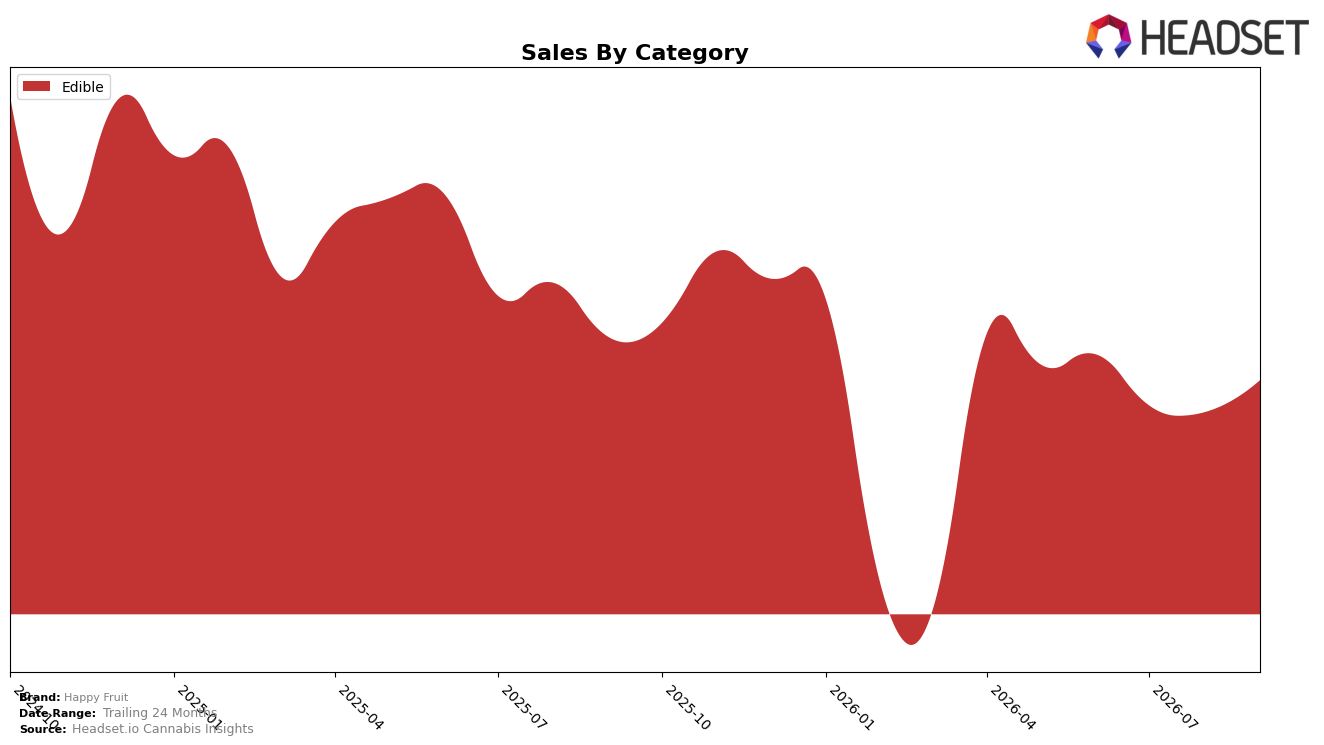
In September 2026, Happy Fruit operated as a single-category brand with Edible accounting for 100.0% of mix, posting a year-over-year change of -9.3% alongside a month-over-month gain of 8.2%; within California Edibles, the brand held rank 25, a position that juxtaposes a -12.4% average price change with a 8.2% MoM sales lift. The combination of a -9.3% YoY decline and a -12.4% YoY price shift, paired with a 8.2% MoM recovery at a $12.28 average price, implies that recent momentum is driven more by price elasticity within Edibles than by mix expansion.
These shifts suggest a positioning anchored in value-driven Edibles: the -12.4% YoY price reduction coinciding with a 8.2% MoM sales increase and a 100.0% category concentration indicates demand sensitivity to price, while rank 25 in California Edibles sets a mid-tier reference point. The pattern—YoY sales at -9.3% against a 24‑month slide of -39.9% and current full reliance on Edibles—implies that incremental share gains are more likely to come from price-pack architecture within the category than from diversification in the near term.
Competitive Landscape
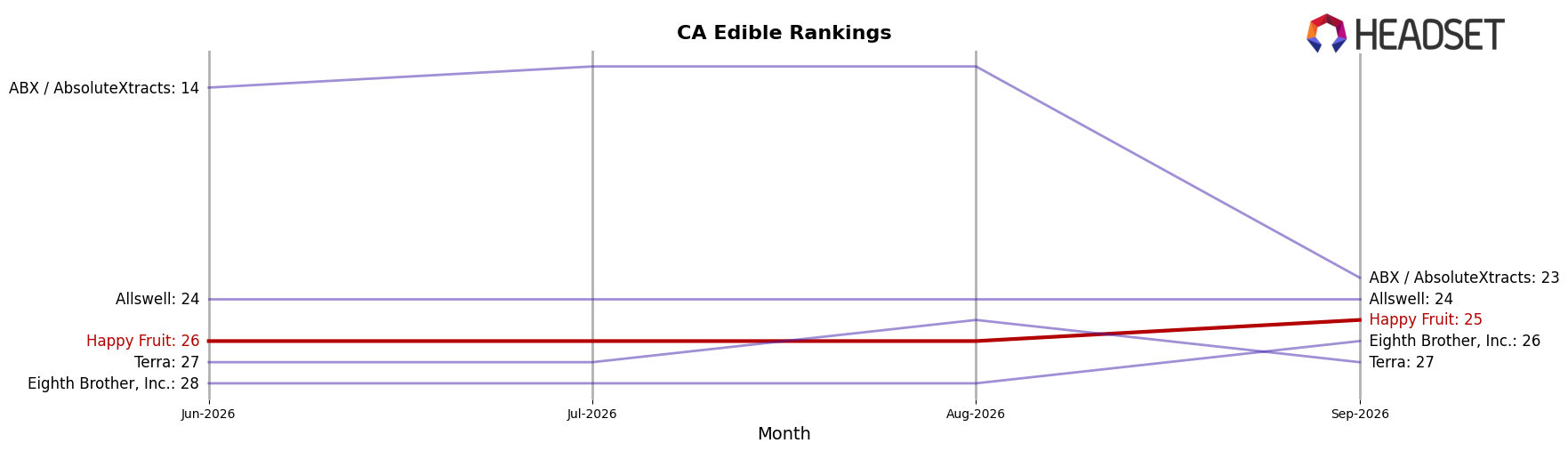
Happy Fruit sits at rank #25 in CA Edible in September 2026, down 1 position YoY from #24 and up 1 position versus June 2026’s #26, while still trailing its peak at #18 from February 2025; in contrast, Wyld holds #1 with a -21.97% YoY sales change and Camino is steady at #2 with +10.39% YoY sales, indicating that category leadership is consolidating even as the leader contracts. Relative rank stability among the top five—#1 through #5 unchanged YoY—paired with Happy Fruit’s slight YoY slippage from #24 to #25 implies that incremental share gains will require displacing entrenched incumbents rather than relying on category churn.
Notable Products
THC/THCV 2:1 Strawberry Limeade Rosin Gummies 5-Pack (100mg THC, 50mg THCV) posted the steepest move in September 2026 with a -15.4% month-over-month drop and slid to rank 7, while THC/CBN 2:1 Moon Berry Indica Gummies 5-Pack (100mg THC, 50mg CBN) climbed 37.1% MoM to rank 1. Watermelon Lemonade Rosin Gummies 5-Pack (100mg) also advanced 38.8% MoM to rank 3, contrasting with a -15.9% MoM decline for CBD/CBG/THC 1:1:1 Peaceful Pineapple Gummies 10-Pack (100mg CBD, 100mg CBG, 100mg THC) at rank 9. Eight of the top ten are Edible SKUs within the rosin or minor-cannabinoid gummy family, and the shift toward CBN-forward and flavor-led rosin formats implies a portfolio tilt toward functional nighttime and flavor-driven use cases over THCV-focused novelty, with September 2026 revenue concentrated in ranks 1–3 totaling $57,327.
Top Selling Cannabis Brands





Data for this report comes from real-time sales reporting by participating cannabis retailers via their point-of-sale systems, which are linked up with Headset’s business intelligence software. Headset’s data is very reliable, as it comes digitally direct from our partner retailers. However, the potential does exist for misreporting in the instance of duplicates, incorrectly classified products, inaccurate entry of products into point-of-sale systems, or even simple human error at the point of purchase. Thus, there is a slight margin of error to consider. Brands listed on this page are ranked in the top twenty within the market and product category by total retail sales volume.

