.svg)

Sep-2026
Sales
Trend
6-Month
Product Count
SKUs
Avg Price
YoY Sales Change
YoY Price Change


Where to Buy
Tru Smoke is stocked at 121 licensed dispensaries across Michigan, with the deepest coverage in New Buffalo, Detroit, Grand Rapids, Adrian, and Ann Arbor. Search by ZIP code or city below to find the closest one, or filter by product type if you are after a specific format.
Market Insights Snapshot
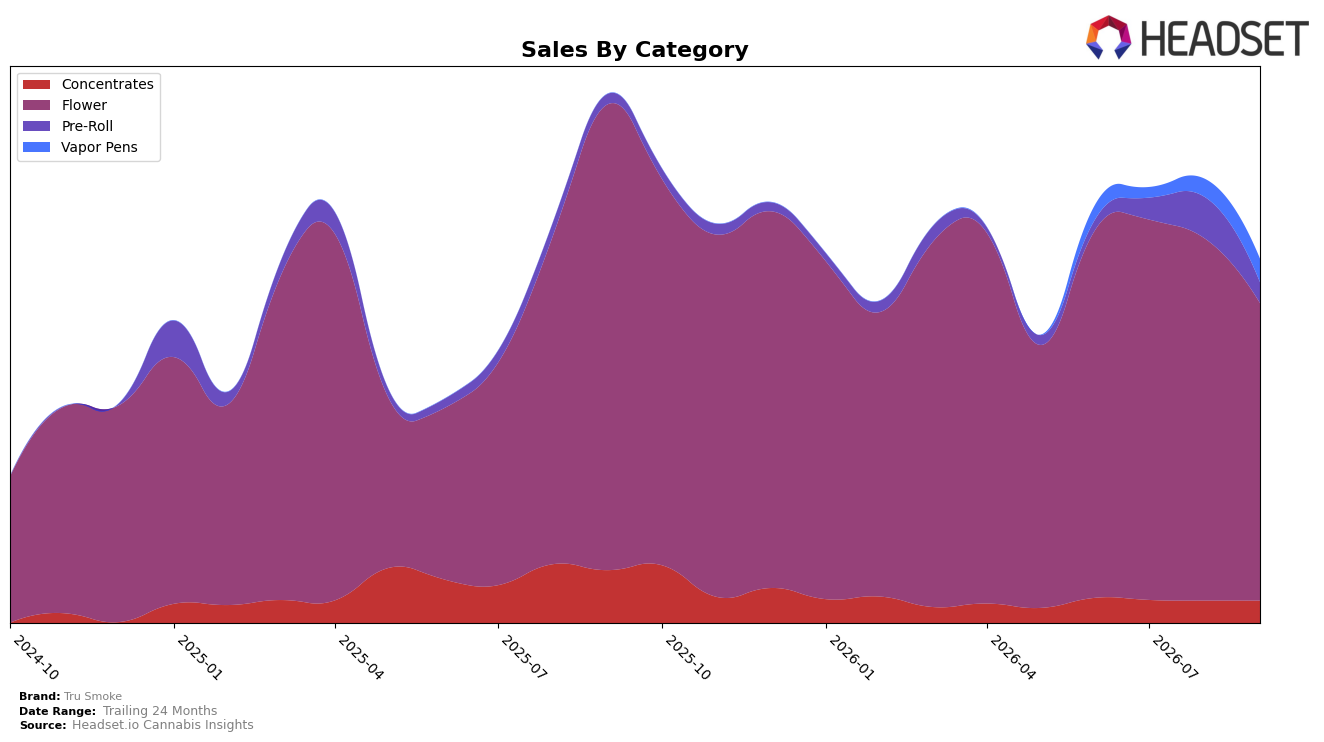
Tru Smoke’s mix in September 2026 was concentrated in Flower at 81.9% share with a year-over-year decline of 36.2% and a month-over-month drop of 17.9%, while Vapor Pens rose 29.9% MoM to 6.4% share but have no year-over-year baseline, and Pre-Roll doubled year-over-year by 104.9% to 5.6% share yet fell 50.1% MoM. Concentrates held 6.1% share with a 58.0% YoY contraction and a marginal 0.3% MoM decline, and average price across the brand rose 168.9% YoY to $24.94 as brand sales declined 31.3% YoY, implying mix pressure from premiumization amid volume contraction.
In Michigan Flower, Tru Smoke sat at rank 30 while Flower’s share within the brand fell 17.9% MoM and 36.2% YoY, indicating declining leverage in the top category even as Pre-Roll’s 104.9% YoY growth and Vapor Pens’ 29.9% MoM uptick suggest exploratory demand pockets. With the brand’s 24‑month growth of 89.4% coexisting alongside a 31.3% YoY sales decline and a 168.9% YoY price lift, the pattern implies Tru Smoke is trading up on price while ceding rank momentum in core Flower, and needs mix diversification to offset sensitivity to Flower volatility at rank 30.
Competitive Landscape
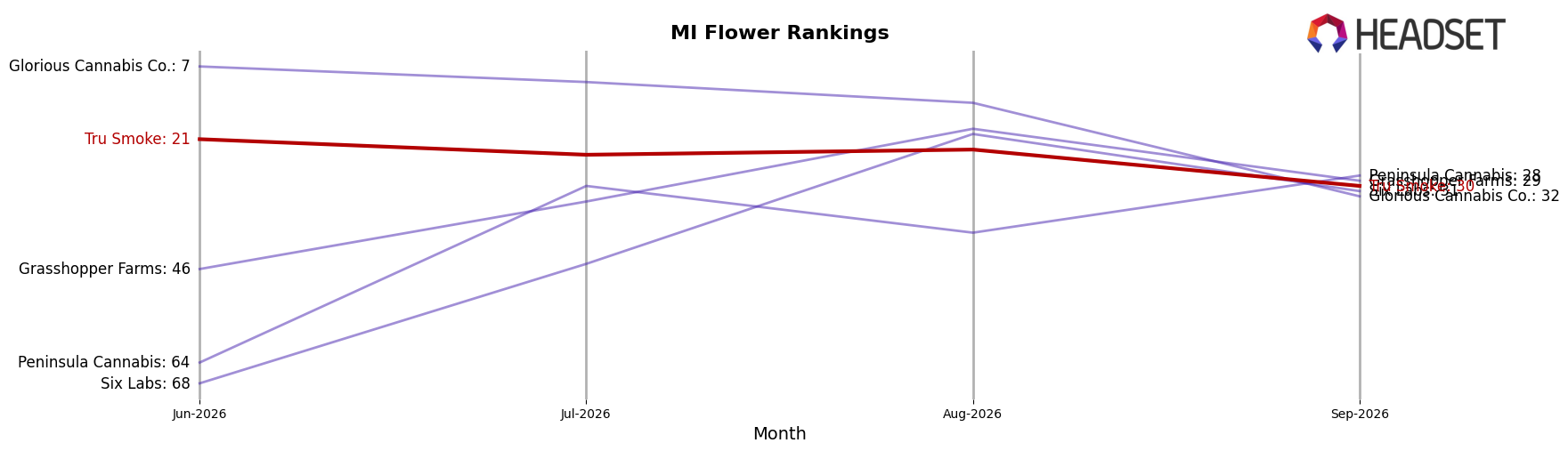
Tru Smoke sits at rank #30 in Michigan Flower with a year-over-year drop of 15 positions, and it also fell 9 spots from rank #21 three months ago, while its peak of #15 in September 2025 highlights a 15-rank slide since that high; meanwhile, High Minded held at #1 year over year despite a -3.3% sales change and Play Cannabis advanced from #7 to #2 with +33.3% YoY sales, indicating Tru Smoke’s relative share is being displaced by competitors that are either holding top positions or accelerating upward—this trajectory implies Tru Smoke is ceding rank to faster-moving leaders and needs a corrective move to avoid further drift from the top 20.
Notable Products
Crunchberries (Bulk) posted the largest month-over-month surge at +74.5% and climbed to rank 2, while Bolo Runtz (Bulk) fell -15.2% and slid to rank 7, signaling a widening gap between rising bulk favorites and trailing SKUs. Mule Fuel (Bulk) advanced +67.6% into rank 3, and Pie Scream (28g) rose +46.5% to hold rank 1 with roughly $121,541, as Flower captured nine of the top ten positions to concentrate share in a single category. The pattern implies Tru Smoke is consolidating around high-velocity Flower, particularly bulk formats, which positions the portfolio for volume-led gains but increases exposure to price compression risk if bulk momentum cools.
Top Selling Cannabis Brands





Data for this report comes from real-time sales reporting by participating cannabis retailers via their point-of-sale systems, which are linked up with Headset’s business intelligence software. Headset’s data is very reliable, as it comes digitally direct from our partner retailers. However, the potential does exist for misreporting in the instance of duplicates, incorrectly classified products, inaccurate entry of products into point-of-sale systems, or even simple human error at the point of purchase. Thus, there is a slight margin of error to consider. Brands listed on this page are ranked in the top twenty within the market and product category by total retail sales volume.

