.svg)

Sep-2026
Sales
Trend
6-Month
Product Count
SKUs
Avg Price
YoY Sales Change
YoY Price Change


Where to Buy
Ayrloom is stocked at 410 licensed dispensaries across New York, Connecticut, and 3 other states, 404 of them in New York, with the deepest coverage in New York, Brooklyn, Queens, Buffalo, and Rochester. Search by ZIP code or city below to find the closest one, or filter by product type if you are after a specific format.
Market Insights Snapshot
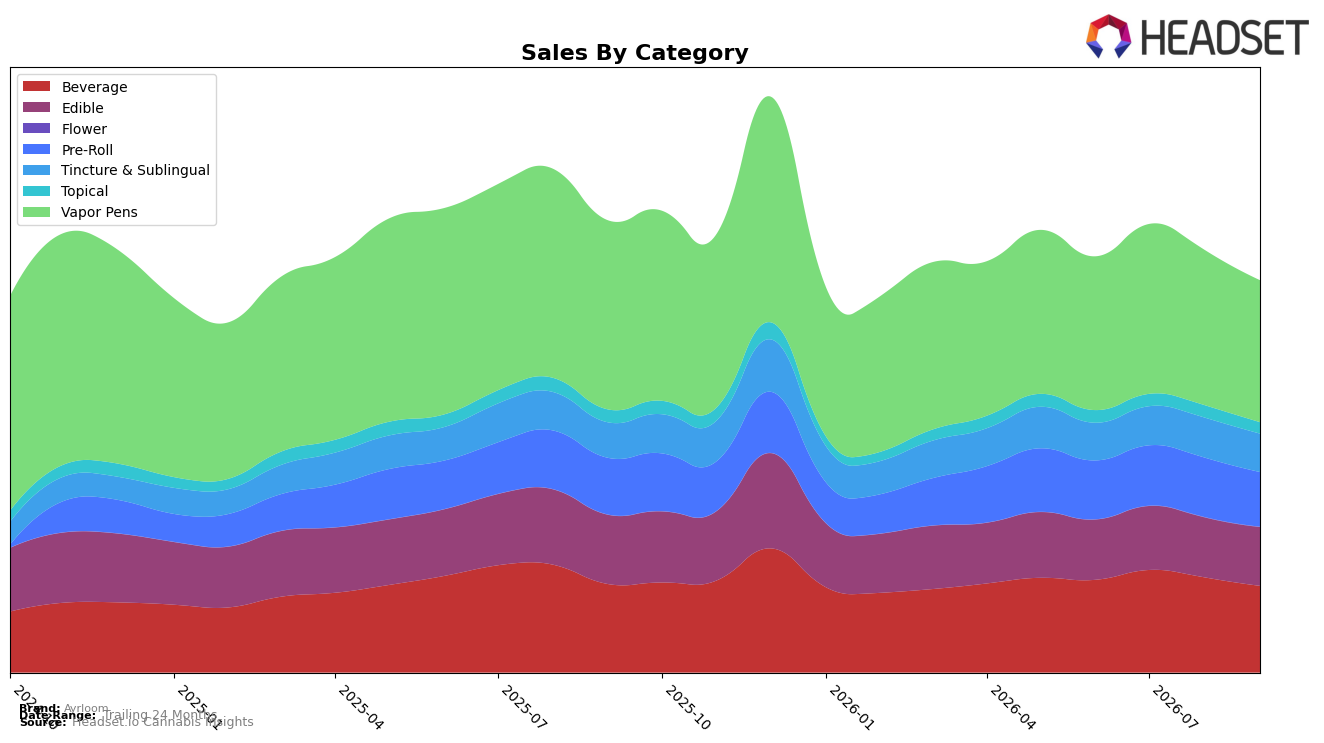
In September 2026, Ayrloom’s mix tilted toward Vapor Pens at 36.27% share, yet that anchor category fell 24.94% year over year and 8.56% month over month, pulling overall sales down 13.27% YoY. Beverage held 22.14% share with a 2.02% YoY decline and an 8.94% MoM dip, while Edible at 15.00% share slid 15.07% YoY but only 1.89% MoM, indicating a slower contraction pace than Vapor Pens’ MoM drop. Pre-Roll contributed 13.91% share, easing 3.75% YoY and 8.20% MoM, as Tincture & Sublingual at 9.77% share was the lone YoY gainer at 8.28% despite a 4.01% MoM step back; Topical at 2.87% share declined 11.47% YoY and 7.92% MoM. The SKU-level pricing backdrop shows average price down 13.40% YoY, and with New York as the top state and Vapor Pens ranked 4 in category, the mix implies margin pressure concentrated in the largest bucket and a gradual shift of stability toward Tincture & Sublingual and Edible.
The pattern signals that Ayrloom’s positioning is overexposed to a weakening Vapor Pens corridor (−24.94% YoY; rank 4 in New York) while the comparatively resilient Tincture & Sublingual growth (+8.28% YoY; −4.01% MoM) offers a counterweight that can diversify revenue density. With Beverage and Pre-Roll each posting mid‑to‑high single‑digit MoM declines (−8.94% and −8.20%, respectively) alongside a 13.40% YoY drop in average price, the portfolio is experiencing simultaneous volume and pricing headwinds that concentrate downside risk in the top two categories (58.41% combined share). Edible’s shallower MoM decline (−1.89%) relative to Vapor Pens (−8.56%) and Beverage (−8.94%) indicates a more defensible demand pocket, suggesting a tactical reweighting toward Tincture & Sublingual and Edible could reduce volatility without abandoning the scale advantages of Vapor Pens.
Competitive Landscape
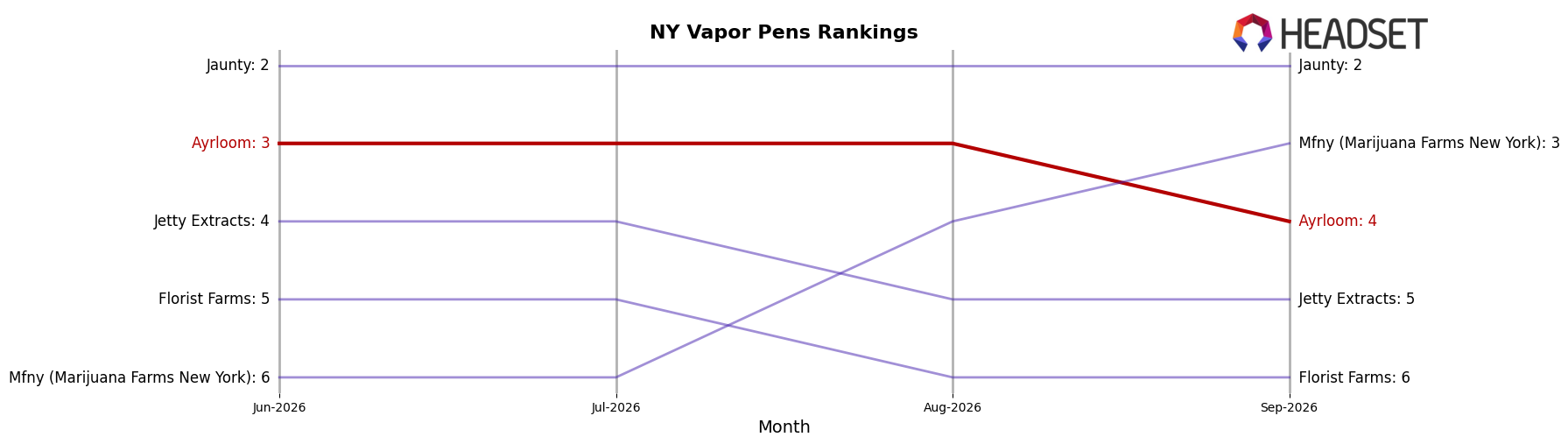
Ayrloom is currently ranked #4 in NY Vapor Pens in September 2026, down 2 positions year over year, and slipped 1 spot since June 2026 from #3, while previously peaking at #1 in December 2024. In contrast, Fernway rose to #1 with a 3-place YoY gain and 18.1% sales growth, and Mfny (Marijuana Farms New York) advanced to #3 with a 5-place YoY climb and 40.5% sales growth; meanwhile, Jaunty sits at #2 despite a 1-rank YoY dip and a 33.0% sales decline. The pattern implies Ayrloom’s slide from #3 to #4 alongside competitors’ upward mobility points to pressure on retention rather than a broad category contraction, signaling a need to recapture share against rising leaders.
Notable Products
CBD/THC 1:2 Lemonade Up (5mg CBD, 10mg THC, 12oz) posted the steepest decline in September 2026 at -26.5% MoM while dropping to rank 8, whereas CBD/THC 1:2 Up Honeycrisp Apple Cider (5mg CBD, 10mg THC, 12oz) also slipped -12.9% MoM but held rank 1. CBD/THC 1:2 Half & Half Lemonade Iced Tea UP (5mg CBD, 10mg THC, 12oz) fell -15.5% MoM and sat at rank 2, contrasting with CBD/THC 1:2 Black Cherry Sparkling Water (5mg CBD, 10mg THC, 12oz) which inched up +6.5% MoM to rank 4 and helped offset declines in other core flavors. With all top-ten SKUs in the Beverage category and only one product above $170,000, the pattern implies a reliance on a broad beverage lineup where incremental gains in sparkling variants must counter concentrated pullbacks in classic lemonades to sustain share.
Top Selling Cannabis Brands





Data for this report comes from real-time sales reporting by participating cannabis retailers via their point-of-sale systems, which are linked up with Headset’s business intelligence software. Headset’s data is very reliable, as it comes digitally direct from our partner retailers. However, the potential does exist for misreporting in the instance of duplicates, incorrectly classified products, inaccurate entry of products into point-of-sale systems, or even simple human error at the point of purchase. Thus, there is a slight margin of error to consider. Brands listed on this page are ranked in the top twenty within the market and product category by total retail sales volume.

