.svg)

Aug-2026
Sales
Trend
6-Month
Product Count
SKUs
Avg Price
YoY Sales Change
YoY Price Change


Where to Buy
Rise (MI) is stocked at 309 licensed dispensaries across Michigan, with the deepest coverage in New Buffalo, Detroit, Lansing, Monroe, and Ann Arbor. Search by ZIP code or city below to find the closest one, or filter by product type if you are after a specific format.
Market Insights Snapshot
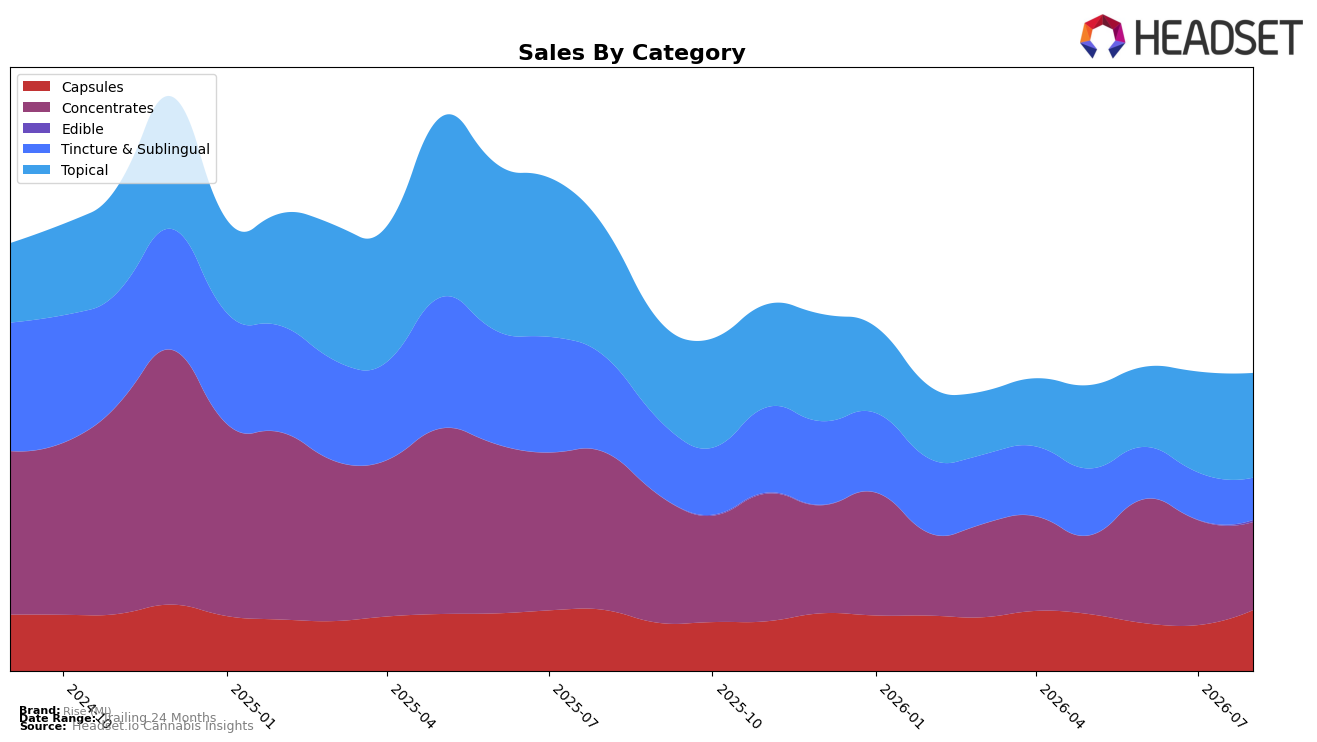
Rise (MI) concentrated 35.17% of August 2026 sales in Topical with a month-over-month lift of 3.85% but a year-over-year decline of 18.97%, while Concentrates held 29.57% share with a 16.10% MoM drop and a 44.25% YoY slide; Capsules expanded to 20.48% share on a 32.71% MoM surge and a near-flat 0.34% YoY decline. Tincture & Sublingual fell 10.69% MoM and 56.07% YoY to 14.17% share, and Edible, though just 0.61% share, spiked 865.39% MoM from a small base; across the portfolio, the average price rose 11.21% YoY while total brand sales fell 33.01% YoY. The pattern implies a pivot toward steadier, lower-volatility Capsules and resilient Topical to stabilize mix as Concentrates and Tincture & Sublingual contract, with micro-bets in Edible testing incremental reach despite minimal share.
Within Michigan Topical, Rise (MI) holds rank 3, which, paired with Topical’s 35.17% mix and 3.85% MoM growth, positions the brand to lean into a category where its relative standing offsets brand-level sales pressure of 33.01% YoY. The 32.71% MoM gain in Capsules alongside a 0.34% YoY dip signals an emergent second pillar that can diversify away from the 16.10% MoM and 44.25% YoY drag in Concentrates; with Tincture & Sublingual down 10.69% MoM and 56.07% YoY, maintaining the number 3 Topical rank while expanding Capsules share offers a pathway to mitigate pricing-driven elasticity from the 11.21% YoY average price increase. The implication is a barbell positioning: defend and monetize the ranked Topical franchise while reallocating capacity from declining Concentrates and Tincture & Sublingual into Capsules and selective Edible trials to rebuild volume without eroding price.
Competitive Landscape
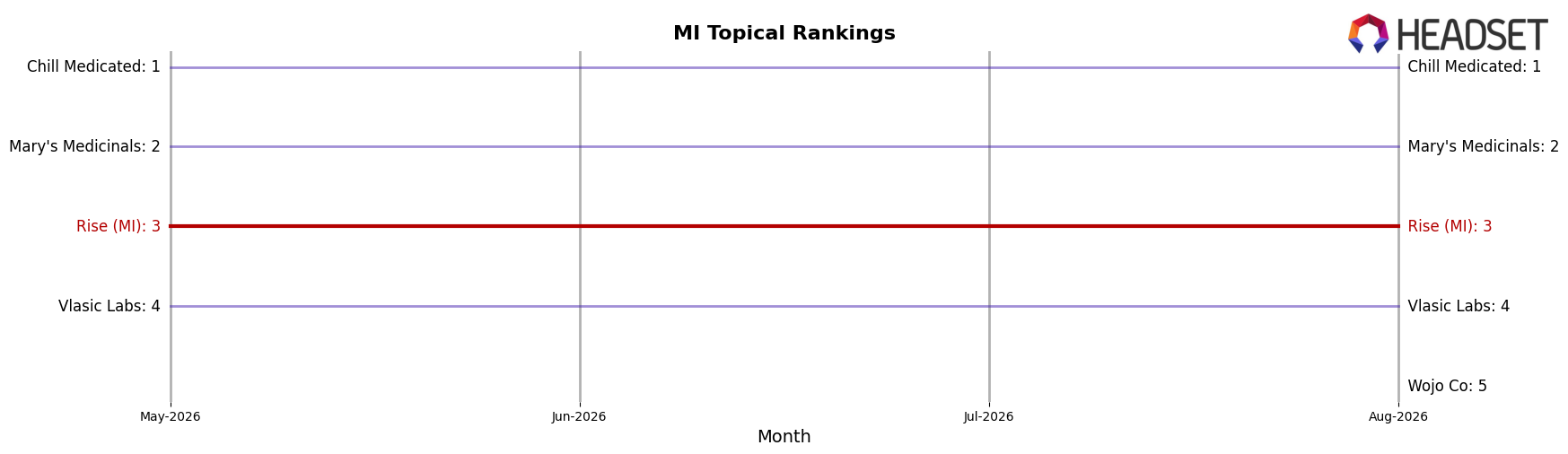
Rise (MI) sits at rank #3 in MI Topical in August 2026, unchanged from #3 in August 2025, and it also held #3 three months ago, indicating a stable but capped position relative to peers; Chill Medicated maintained #1 year over year with a 12.1% YoY sales increase while Mary's Medicinals held #2 as its sales declined 21.7%, creating a mixed competitive gap above Rise (MI) even as Vlasic Labs remained #4 but expanded sales by 58.6% to pressure from below; this flat rank trajectory—peaking at #3 in August 2026 and not advancing despite a competitor’s double-digit contraction—implies Rise (MI) is locked in a middle-tier equilibrium that risks future share erosion if accelerating #4 momentum persists.
Notable Products
CBD/THC/THCa 1:2:1 Advanced Strength Cream (250mg CBD, 750mg THC, 250mg THCa, 1oz) posted the largest movement in August 2026 with a 104% month-over-month gain, vaulting into rank 4, while Hybrid RSO Dart (1g) fell 26% to rank 2. Topicals concentrated the leaderboard with three of the top four ranks as Unscented RSO Cream (1000mg THC, 1oz) held rank 1 at +24% alongside the 1:2:1 cream’s surge, whereas Hybrid RSO (1g) dropped 23% at rank 8. The split between rising topicals and declining RSO concentrates implies an accelerating pivot toward therapeutic-format topicals over legacy RSO ingestion, suggesting near-term merchandising should favor higher-velocity creams over syringe-based concentrates.
Top Selling Cannabis Brands





Data for this report comes from real-time sales reporting by participating cannabis retailers via their point-of-sale systems, which are linked up with Headset’s business intelligence software. Headset’s data is very reliable, as it comes digitally direct from our partner retailers. However, the potential does exist for misreporting in the instance of duplicates, incorrectly classified products, inaccurate entry of products into point-of-sale systems, or even simple human error at the point of purchase. Thus, there is a slight margin of error to consider. Brands listed on this page are ranked in the top twenty within the market and product category by total retail sales volume.

