.svg)
Two Years In: Winners, Losers, and the Brands Reshaping New York Cannabis

Two Years of Data. One Clear Story.
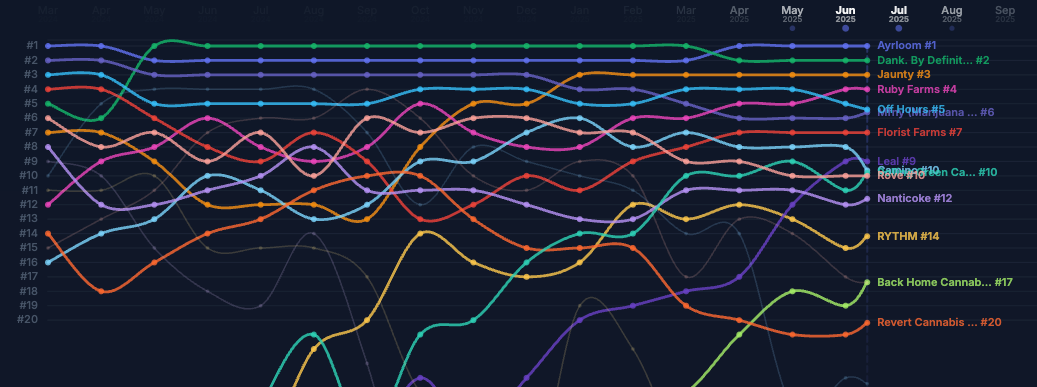
New York's legal cannabis market turned two years old in early 2026, and we now have enough data to separate signal from noise. Using 24 months of brand-level sales rankings from March 2024 through February 2026, we can see which brands built something durable, which ones caught lightning in a bottle, and which ones lost their footing in one of the country's most competitive markets.
Here's what the data tells us.
The Two That Own the Market
No analysis of New York cannabis starts anywhere else: Dank. By Definition and Ayrloom have been the top two brands in the state for nearly the entire tracking period. Dank has held the #1 position in 20 of 24 months, while Ayrloom has locked down #2 for 17 of 24.
What makes this dominance remarkable isn't just consistency — it's the margin. Both brands established themselves early and have shown an ability to scale with the market rather than being diluted by new entrants. In a state where dispensary count has grown rapidly and shelf space competition has intensified, holding the top positions month after month signals real consumer loyalty and strong distribution.
Dank's appeal centers on value-driven flower and pre-rolls that resonate with New York's price-conscious consumer base. Ayrloom, meanwhile, has carved out a distinct identity in edibles and vapes, giving the two brands surprisingly little direct overlap despite their proximity in the rankings.
The Breakout Stars
Several brands have made dramatic upward moves over the 24-month period, climbing from the bottom of the top 20 — or outside it entirely — into serious contention.
Leal is perhaps the most impressive mover in the dataset. Starting at #18 in March 2024, Leal climbed steadily into the top 10 by mid-2025 and finished the period ranked #5. That kind of sustained ascent — without a single dramatic spike or collapse — suggests the brand is building genuine market share rather than riding a promotional wave.
Jaunty tells a similar story, rising from #12 to #4 over the tracking period. Jaunty's strength in the vapor pen category has been a key driver, as New York consumers have increasingly gravitated toward convenient, discreet form factors.
RYTHM, backed by GTI's multi-state operational muscle, climbed from the #8-#10 range into a steady #5-#7 position. The brand benefits from reliable supply chain execution, which matters enormously in a market where stockouts and inconsistent availability have hampered competitors.
Rolling Green Cannabis and Back Home Cannabis Co. are worth watching, too. Both entered the rankings relatively late but have shown strong upward trajectories in recent months — the kind of early momentum that often precedes a bigger breakout.
The Brands That Lost Ground
Not every story in the data is a happy one. Several brands that were top-10 fixtures in early 2024 have seen significant declines.
FlowerHouse New York is the most dramatic fall. Once ranked as high as #3, FlowerHouse dropped to #16 by the end of the tracking period. The decline was gradual at first, then accelerated in the second half of 2025. In a market with this many options, losing shelf velocity can create a vicious cycle: fewer sales lead to less prominent placement, which leads to fewer sales.
LivWell followed a similar trajectory, dropping from #6 to #14. The brand's early strength appears to have been tied to limited initial competition, and as the market matured and new entrants arrived, LivWell struggled to differentiate.
Hepworth slid from the #7-#8 range down to #17, a particularly steep decline for a brand with strong local roots. Matter. similarly drifted downward from mid-pack to the lower end of the rankings.
Even Rove, a well-known multi-state brand, couldn't maintain its early positioning. After entering the New York market with name recognition and an established product line, Rove peaked around #5-#6 but has since settled into the #10-#12 range as locally-focused competitors gained traction.
The Steady Hands
Some brands deserve credit for doing something that sounds simple but is actually quite hard: staying in roughly the same position for two years.
Off Hours has been remarkably consistent, hovering between #3 and #5 for nearly the entire period. In a market defined by volatility, Off Hours' stability suggests a well-dialed product-market fit and reliable execution.
MFNY, Ruby Farms, and Florist Farms have all maintained mid-pack positions with minor fluctuations. These brands may not generate headlines, but their consistency reflects sustainable business models that aren't dependent on heavy discounting or promotional spending.
Camino, the popular gummy brand from Kiva, has similarly held a steady mid-tier position — neither surging nor declining meaningfully over the period.
What It All Means
Twenty-four months of data reveals a New York cannabis market that is maturing faster than many expected. The early land-grab phase is over, and the brands that are winning now are the ones with genuine consumer loyalty, consistent product quality, and strong distribution networks.
The data also shows that multi-state brand recognition alone isn't enough. Brands like Rove and LivWell entered with built-in awareness but couldn't outperform locally-focused competitors who understood New York's unique consumer preferences. Meanwhile, brands like Leal and Jaunty have proven that it's still possible to break through — if you have the right product and the patience to build methodically.
For industry observers, investors, and operators alike, the message is clear: New York's cannabis market rewards execution over hype, and the rankings are far from settled.